

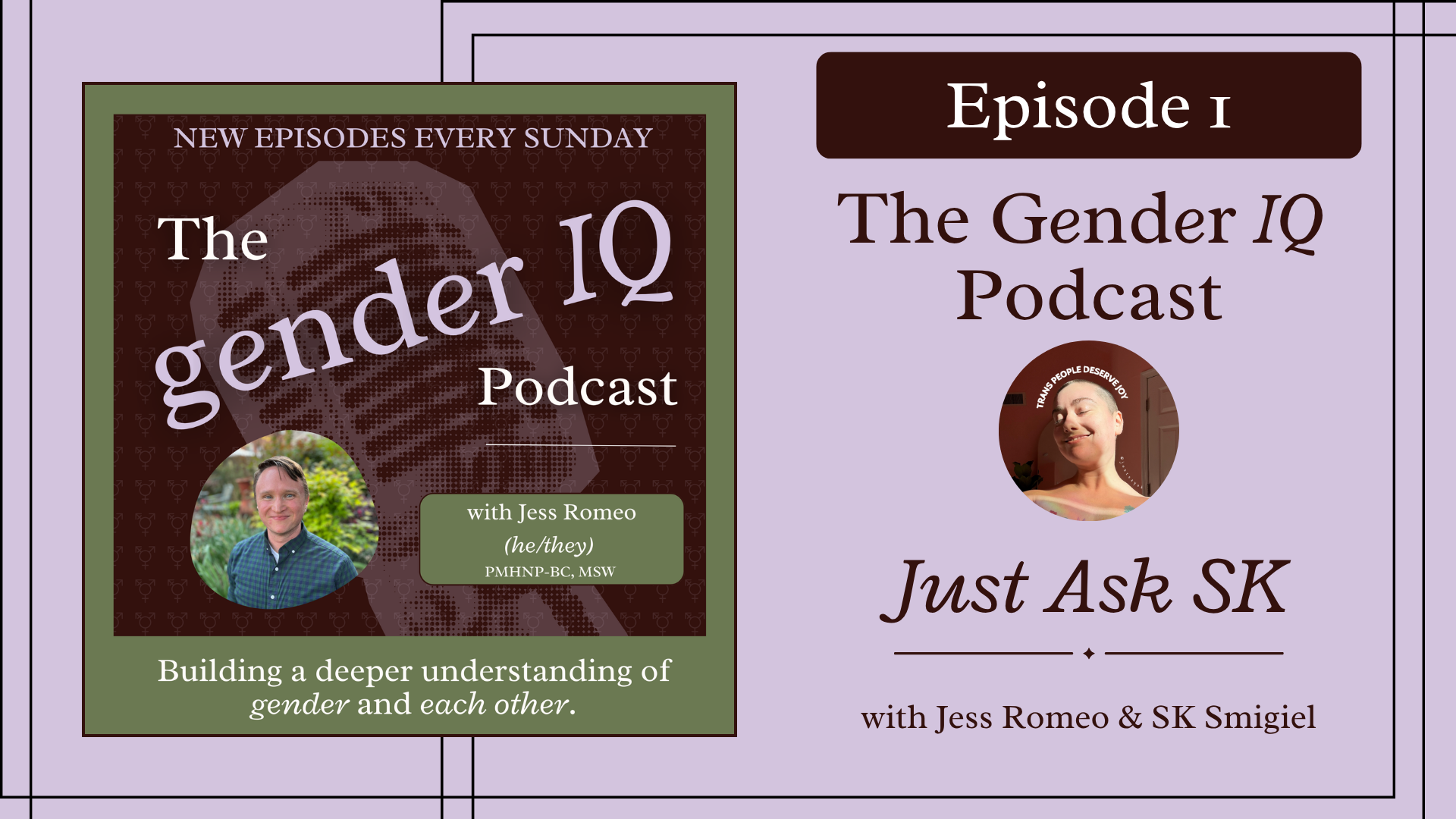
Episode 1: Just Ask SK (Part 1)
Episode Overview:
In this conversation, Jess Romeo and SK explore the complexities of gender identity, personal growth, and the transformative power of self-discovery. They discuss the importance of empathy, community support, and the evolution of their identities over time.
Together, we discuss:
✨ Growing up queer in a conservative home—and how it shaped SK's activism
✨ Using humor to challenge gender norms and build connection
✨ The challenges of being a trans educator online (and how they handle the hate)
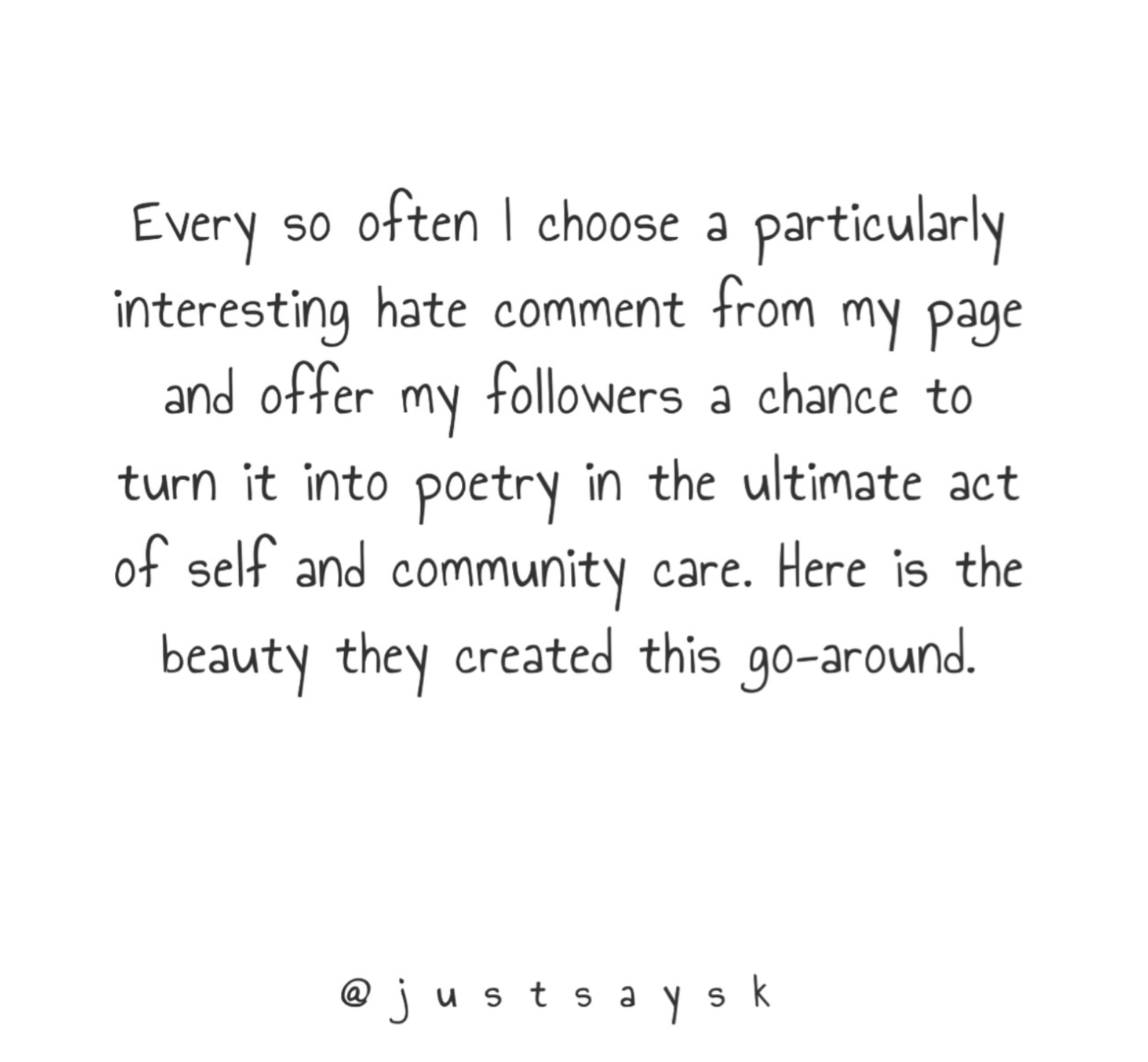
✨ How their viral “Hate Erasure Poetry” series turns negativity into affirmation
✨ Why gender should be an adventure, not a test
About the Guest
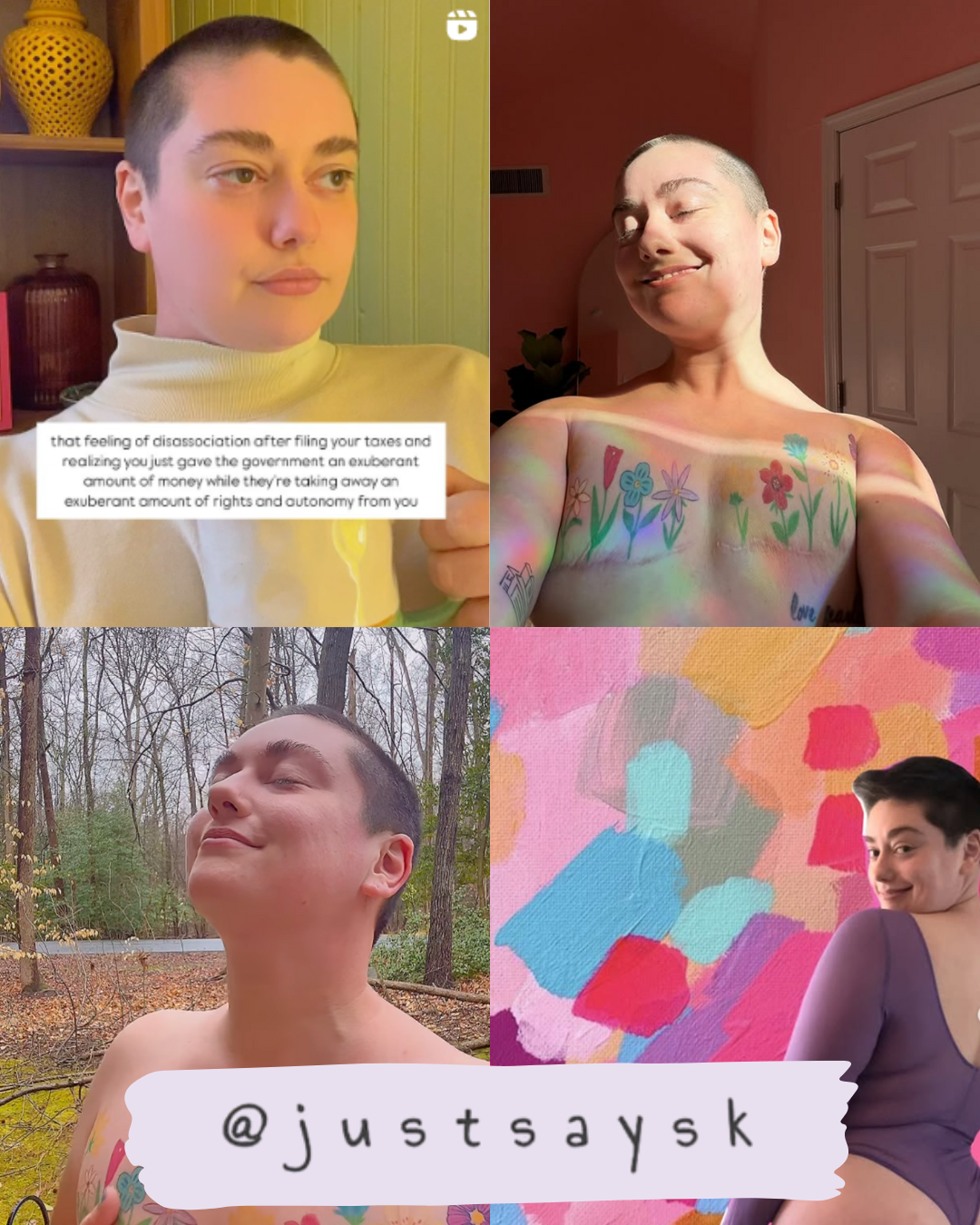
SK Smigiel (she/they) is a gender bender and educator doing her part to uplift and celebrate the queer community.
Now SK uses their platform to educate about queer topics through lived experience and graphic storytelling.
@justsaysk
👇 on Instagram 👇
-
Jess Romeo: But yeah, it's rough time. So I appreciate you taking the time to do it. How have you been with all of this lately?
SK: It's day by day, right? Like it's like I'm okay. I'm safe. I'm alive. I'm breathing. But I'm yeah, going through it. I think if I wasn't moving homes right now and didn't have like something really positive and monumental to focus on, I don't think I'd be doing as well. yeah.
Jess Romeo: Yeah. Makes a lot of sense. Well, it's like, I feel like your presence is almost more important than ever right now. I don't think, I think I told you like how I came across your account. Like I was encouraged to find your account when I started doing anything on social media, because somebody who knew what they were talking about was like, well, you're going to need to manage hate comments. Here's a person who does it really, really well. and that's how it started, but I'm just obsessed with, I'm obsessed with so much of your content. It really is just lovely.
SK: Thank you, I appreciate that.
Jess Romeo: Yeah. Well, let me read the intro because I hadn't, meant to do that before. And that might, I don't know what you thought about it, but, this feels very true that if the internet had a gender, it would be SK's playground. and also what do you prefer to be called and like pronounce last name is good.
SK: SK is good. last name is Smeagol rhymes with eagle, legal. Yeah.
Jess Romeo: Perfect. Perfect. But yeah, the internet had a gender would be SK's playground. There's something magic about the way SK plays with gender, not in a way that confuses, but in a way that liberates. Through their sharp wit and signature warmth, SK invites everyone, queer, questioning, and cis-alike to approach gender with curiosity, humor, and ease. If you've ever felt the pressure to get gender right or worried that your understanding is behind the times, SK's Instagram page is the internet's coziest permission slip. explore. The work doesn't demand you to be perfect, it just invites you to play. By the time you're done scrolling you won't just be laughing, you'll be thinking too. So I'm so excited to be talking to them today and to bring this conversation to you.
SK: Thank you. That was a really, really wonderful intro.
Jess Romeo: Yeah, it's, it really is just a love you page. and I always like to get to know people like as in depth as they are comfortable with to be able to share that with others. So I know like you grew up as the kid of a conservative state legislature, a reality that seems world apart from a lot of the work that you do now. What was your relationship to gender and queerness in that environment?
SK: Yeah, I was actually just talking to my partner about this this morning as I was preparing to talk to you today. And it brought back a lot just thinking about just, yeah, such the difference of the way I was raised and the life that I lead now. So I actually still live in the town I grew up in, which is funny because I'm such a different person. Just moved into a brand new home here. But living here as a child, really small town, about 700 people. It's actually pretty, it's like a nice mix of conservative and more liberal, more open. But the conservative side is, it's just very small town. It's very farmland. Everyone around you is, you know, that kind of mindset of living small, working on farms, that sort of thing. My dad, as you mentioned, worked as a Republican state delegate for eight years during my childhood. So two, two elections that he was elected. So he worked at the state capitol, which meant he was out of the home most of the time when he was living in Annapolis to do the work that he did. Yeah.
Jess Romeo: Yeah, and was this when you were like young, Chuck? Because I feel like those eight years, when those eight years happen is important.
SK: when I was seven to fifteen.
Jess Romeo: Okay, so like super, yeah, very aware, very formative, but you're very aware also, and that evolves with time.
SK: Yes. Yes. So he was also an attorney, which was his main, you know, job role. So he continued that throughout all of this, you know, like legislative work that he did. But yeah, so he was elected when I was seven or maybe eight to the Maryland House of Delegates as a conservative Republican. And the thing was, as a child in a home where your parents' job, like any other child, is what puts food on your table, it's what allows you to go to dance class and to buy the clothes that you want and go to the movies with your friends. I supported my dad as a person who worked hard to pay bills for our family. So all I saw was hard work and caring deeply about his community and what he believed in and fighting hard for the things that mattered to him. I mean, it wasn't until I was older that I started to realize some of those things that he felt so strongly about were things that I felt opposite about. I mean, I guess 12, 13 years old, you start to have an awareness politically, an awareness culturally about what's going on around you. And especially as someone who's queer, who's neurodivergent, didn't have the words for it at the time. But understanding I was different, understanding that I wasn't like the people in my town or the people around me or my peers, or even my family members, I was. I challenged him. I was outspoken. We butted heads a lot. My dad always told me I should be a lawyer because he was like, you argue like a lawyer, but you don't get paid like one. But we had healthy debate, which was interesting. When I tell people that I was a Republican state delegates kid, it's always like, that probably was really rough. And yes, there were things that were rough, like sitting at the kitchen table, hearing conversations about bills that would legislate my existence away without me understanding the language of it and who I was. But he also worked across party lines a lot, cared about some things that I cared about. So there was nuance. And I think that all of that really led me to be able to educate to masses the way that I do now. I have perspective that I think other people don't have.
Jess Romeo: that actually really resonates with me. And I also feel like zooming out from even just the family environment, that feels like huge, your relationship with your dad, but it was happening in a really small town. I've had a lot of conversations with people like this, where if you live in a larger city or even a really big suburb where folks are more anonymous, it's easier to stay in your echo chamber and sort of have fairly fixed viewpoints and not challenge those. But in a small town, You gotta band together like everybody knows one another. It's just not that easy to throw people away like that. Yeah. Yeah. That does it ever lead to any conflict with any of your followers or other creators? Because that nuance, like I see it in your content, but I wonder how it lands with some people if you've had those conversations.
SK: Yeah, I think that the way that I approach education and create creation in general is that I'm creating for anyone to pick up that post or that piece of information and meet them where they're at and let them use it as a starting point. If I'm talking to someone who's quite well versed in gender and the political dynamics of today, and this is additional information for them or support for them, they already know where I'm at. people generally, it's more of a positive response from people who are like my dad or who are married to people like my dad or who are just ignorant and don't have the knowledge yet because you don't know what you don't know. Those people, right, yes, and those people are the people who then follow my page because they feel it's a safe place to learn, which I make very clear. There's a lot of creators online who are doing queer work who I don't blame them, don't have the time, the patience, or the willingness to meet people who don't already have a basis of knowledge about queerness so that they can expand their knowledge. That's valid. That's not the work that I do. So generally it's perceived really well, but I mean, I've encountered people who are even extremists for me and in the leftist way that don't appreciate my willingness to meet people who don't know yet to help to help guide them through that those very first steps.
Jess Romeo: Yeah. And again, like all valid across the spectrum. I think I can have a lot of empathy for that response. And I think it's unfair to categorize it as a trauma response from folks like that across the board. But I do, I do think that that's true for a lot of folks. And again, who can blame them when the resources there to be able to cope with trauma and heal from trauma are so few and far between and hard to find. yeah, I appreciate the perspective. I feel like I'm I strive to be somewhat similar, like being from, I'm not from as small a town, but being from the South and having a family that is overwhelmingly conservative, like it's, it's just not that easy to take such a hard line and being willing to engage in those conversations. It feels like it's not a fixed point. Like it evolved over time as I evolve into more authenticity and healing of my own. I wonder if that has that shifted for you? as well over time where some things are harder now than they were five years ago maybe?
SK: Sure, there's a healthy mix of both, I think. I think I've said out loud, and I do believe this, I think that if I wasn't queer, I would still be as empathetic and as caring about the world in general as I am now. But my queerness is what made me have these conversations, is what made me be this advocate. And I don't feel that I have an option, right? I can exist quietly and not have these conversations or I can be honest with myself and the people who love me and who I love and have them. Yes, some things have gotten harder as I've become older because I do have boundaries that I'm not willing to cross anymore. And I'll put up a wall at a certain point and be like, this conversation isn't worth my relationship with someone and I'm not going to be erased or ignored or invalidated to a point. So then the conversation stops, right? And I have to know that line. When I was younger, I just keep fighting until I cried and it was frustrating and we weren't actually hearing each other. So maturity has changed that. But yeah, it's more about boundaries, I think now, just realizing I have to protect my own peace before anything else.
Jess Romeo: Yeah, a lot of self-compassion in that. Did you come to that yourself or did you need support from chosen family or other folks to sort of prompt you to, like you can respect yourself. It's okay to not keep engaging.
SK: Sure. I think it's important to get that from other people. I think that's why I chose family community. Allyship matters. Partners who support you, friends who get you. But I think a lot of it was done on my own, just with my personal circumstances. I went through a couple relationships where I didn't have a partner that fought for me. I didn't have friends who understood me. So I was very alone and independent in my advocacy for myself. And I think through those experiences and maturing, like throughout my 20s, I just stepped away from those people, strength in myself, and then the right people, friends, partners came to me from that. That was my personal experience, but I think people who are able to do it through the support of chosen family is ideal.
Jess Romeo: Yeah. Yeah, I've heard that described. I think this is a Buddhist thing of the process of emotional maturity and leaning into authenticity and self-compassion. It's like meeting your edges and softening. So like just less spiky over time and more spiky over time in some places where I get to be spiky. Yeah, where it matters. Yeah. I had something that I didn't write down that you made me think of. I didn't want to ask about like your partner and family as much as you're comfortable, because I know we're both kind of new parents in a way.
SK: Sure, yeah. I moved in with my partner and her two kids seven days ago. So we're at a one week mark. We've been together for two years. I've been in the kids' lives the entire time, besides the first initial couple weeks of dating. So it's not anything new for me necessarily, but living in one home definitely is new. I'm used to living alone. So going from just me to me and a partner and two kids and a dog and a cat has been an adjustment, but it's a beautiful transition for me. The kids have been wonderful with me from the start with my identity, with who I am. I'm the first queer relationship they've seen their mom in as well. So that, they do, they do. They don't, and this generation's wonderful. They're a little bit older. They're middle and high school aged. So they're aware enough of what's going on. to understand the nuances of our relationship and what we're facing. But they've been just a wonderful addition. I'm also a nanny and I've taught kids dance and yoga and all sorts of other things for many years. So being around kids is nothing new to me, but living with two that are now mine to help parent is definitely new and exciting.
Jess Romeo: Kids get it though. Like kids, don't have all the shit that we have. Yeah, I bet it is. How did y'all meet you and your partner? Mm-hmm.
SK: We met on Hinge and it's funny because it was at a time when we both were done dating. Like I had deleted all of my dating apps besides Hinge and I didn't check it. I had just been single for about two years and I was like, you know, I'm just gonna do this life thing on my own. I'm good, I'm in a really good space and she was doing the same thing and we matched one day randomly and we never saw anybody else again and it just happened.
Jess Romeo: That's really awesome. Yeah, it just happens in those moments. Isn't Hinge the one that markets itself as like the dating app that's meant to be deleted or something? That's a pretty good hook. I remember seeing that. was like, that's good. That's good. Yes, absolutely. Yeah. And see, that's also a good example of like my own bias. Like, thanks for saying that because it's just something that doesn't come to me in that moment.
SK: I think so. Yeah, it is. Yeah, for monogamous folks, that's the one. That's the slogan that'll get you, I think. Well, yeah, I'm monogamous, but I try to be mindful of other people that I can imagine sitting next to someone who's like, poly or open and being like the dating app designed to be deleted. That's not like, that's not it for me. So yeah, trying to be mindful where I can be.
Jess Romeo: Yeah. Yeah, that wouldn't resonate. Mm-hmm. Well, I know we've talked about like your dad, but I know that early in life, not only your town, but dance was a really big impact on you. I'm interested both in dance as an exploration of body and gender and also the ways in which it constricts too.
SK: Sure. Yeah, I actually just wrote a whole Patreon post about this because I have had a lot of people ask me similar questions. I have an interesting upbringing. We've already kind of gone over my political and home life and in the way that it was specific and unique. But I was the first daughter, air quotes, first granddaughter, first girl cousin, first any girl that my mom had brothers, my dad had brothers, everybody had boys.
Jess Romeo: Air quotes, big air quotes.
SK: And then when I was born, it was very instantaneous. This is a girl. She does girl things. I was put in dance at like two years old, which yeah, yes. And now looking back, like I talked to my mom about it very openly. We have a great relationship and she's like, I should have put your brother in dance too. It was never a gender thing. I just didn't know any better. So we have good conversations now, but I mean in the nineties, there was just a different time. so my mom didn't have the resources, right? So
Jess Romeo: they leaned in hard. Got it, yeah. Yeah, like who knew.
SK: two years old girl, pink, put in dance class, and it very quickly became my life. I danced throughout, until I was 18, seven days a week. I would leave school early to go there. I was really close to being homeschooled to take my dance to a professional level. I would be at the dance studio more than school all day on the weekends. I traveled every single week during the summer to a new state to take a different intensive at a different place. I majored in dance in college. I have my degree in dance. I danced professionally for a time. So for those who don't know about the dance world, it is one of the most binary structured, traditionally binary structured art forms or sports that you can be in. It is changing. I've heard that it's changing. It's evolving with the times slowly, but it is for our youth.
Jess Romeo: Wow. You think of so many styles when you think of partner dance especially that literally there is a lead and a follow and that is based on gender roles completely.
SK: Yes, and now it is changing. Even the words you use, like lead and follow are used now, but before it was male and female. Like very much that's what it was called. And so yeah, like that's in like, you know, ballroom salsa, things like that. I took ballet, tap jazz, modern, contemporary, hip hop, point work. Those styles, especially the ballet world, from the time you're two years old, the boys wear black, the girls wear pink. Girl's hair has to be longer than shoulder length to pull back in a bun. Boy's hair has to be above the ears so that when they're on stage, you can tell they're a boy. Costuming, even the boys up until age like 12 have their own class because they want the boys to feel comfortable to go to dance because it's a girl thing. Like it's just so gendered and I didn't know any better. So as a neurodivergent person too, it was interesting because looking back, dance taught me how to emote. your teacher would sit you down and say, make this face, this face means this emotion. And I think I'm so well masking sometimes or high masking in situations, people wouldn't know I'm neurodivergent because I was taught how to emote very specifically. I, yeah, yep, very, very specifically. And it ties back to gender as well in that I was trained how to play a role. So I think it made me mask gender and neurodivergence until a much later age than I would have without being literally guided on how to do it.
Jess Romeo: Yeah, that makes a ton of sense to me, knowing so many neurodivergent queer and trans folks and the ways in which some of these roles both taught them how to fit in and not get seen as some sort of standout, but that that is its own prison as well that you learn over time.
SK: Yeah, and at the time it was such a safe place for me. It was the first place I was exposed to queerness without even realizing it. I met a lot of queer people through the dance world, especially gay men, lots of gay men in the theater world and in the dance world that I was in. And while it wasn't talked about, it was exposure that I understood. And it's just this innate feeling of knowing there were adults who were like me. So I am so thankful for it in so many ways. It made me the successful driven hardworking person I am. It gave me exposure, but it also quite literally created boxes for me to fill in and created a scenario where I was praised by the adults around me when I performed literally the gender and the emotions that they asked me to do. So my life became a performance and there was a really hard line that I had to like differentiate later of what was I taught and who am I, which was an interesting thing I didn't get to discover until my mid-20s because I was dancing professionally still into my 20s.
Jess Romeo: Wow. And I would imagine it's still unfolding like it is for any of us too. Yeah, what were some of those first steps into kind of shedding some of those layers? I can imagine a big haircut as like, I can imagine that as a symbol.
SK: Yeah, that's exactly what I was gonna say. I remember the first time I had hair lower than my shoulders my whole life because literally told you cannot cut it above your shoulders. If it doesn't fit in a bun, you will not be casted and you won't perform, which is what I love to do. So I kept it long, kept it long. Throughout college, if you were casted, you had to ask permission from one of the choreographers if you could even dye your hair, let alone cut it. because you were their artistic property. But when I stopped dancing professionally, I was teaching full-time, teaching dance. And I remember I was teaching to a room full of toddlers, and I was probably 23, 24. And I remember leaning over, and my hair just kept falling out of my ponytail, and I was tucking it back. And I said, I'm just gonna shave my head tonight. And then I had this moment where I was like, I can do that. And I swear to you, I went home. to my bathroom and took out clippers, because I had an undercut, because I thought that was like a nice little like, yeah, yeah. I had like just the tiniest undercut. I took out my clippers and I just from the front to the back shaved my head and I said, okay, never had a shorter haircut, never had anything above here. I just shaved my head in my bathroom and it was the most liberating thing I had ever done. And that was like my first step of like, I have control of my body. This is like consent and autonomy.
Jess Romeo: Uh-huh. That's a really, yeah, that's so powerful. And I think so many people like cis and trans, you know, to be queer, to be queer, to be clear, can all relate to, I know, crystal queer, could relate to a moment of freedom like that. Cause I, I don't know, I feel like I've described this to people sometimes because first of all, it's when people talk about the choice or decision. to take steps towards gender affirmation or towards transition, like whatever word makes sense to the person. There's this sense mostly from cis folks, but I think internalized transphobia can play this role too of thinking I must be 100 % certain to be able to take that step. And I know, I find that I'm rarely 100 % certain about anything. The closest I can get is about 90 and the other 10 % are only gonna come after I make the decision. Like that's how I'm going to know. And so I see like things like that, a change in hairstyle or just something that is a radical shift. It's only after doing that that you can really assess, okay, how does this feel? Does this feel right for me? Am I freer or more me?
SK: Exactly. Yeah, I tell people that and calls a lot. I have one on one calls with people about preparing for gender affirming surgery or just like gender exploration. And a lot of people's like number one concern is will I regret this and what if I do and whether it's a haircut, whether it's coming out, whether it's using different pronouns or getting top surgery. I say, well, what what if you don't do it? Will you regret that? And then you always see this like light bulb of like it's the same thing. If I do it, I might regret it. If I don't, I might regret it. And I think, yeah, it's the thing, the narrative that's pushed on us that we have to be 100 % sure to do anything, limits us. It limits all of us from taking leaps of getting closer to who we really are.
Jess Romeo: Yeah. Yeah, absolutely. I'm really curious. So like your work, it's really funny. First of all, it's like deeply funny, but I know, and a lot of other queer folks know that like humor is often born out of tension, out of pain, or just the absurdity of all that has humor saved you helped you process the heavy stuff or what, how do you relate to that?
SK: I think that I know that a lot of my work comes across funny, lighthearted, jabbing at something, poking fun. That's just me. That's just how I cope. I don't think I ever made a conscious decision to use humor to navigate queerness or navigate neurodivergence or navigate just identity in general. I think that it's just been something that it comes naturally. And I think that that is Okay, I think sometimes people get really serious about gender, especially people within the community, because it means so much to them, right? And they're fighting against an oppressor, they're fighting against internal oppressors and external oppressors. And it's like, you can fall into a trap of being so serious all the time. I've been there. But I think being able to just take a step back and find light and joy and humor, even in the bad stuff. is what's going to get you through. Like we can't bog ourselves down with just total seriousness at all times. There's room for that, but like we gotta play too.
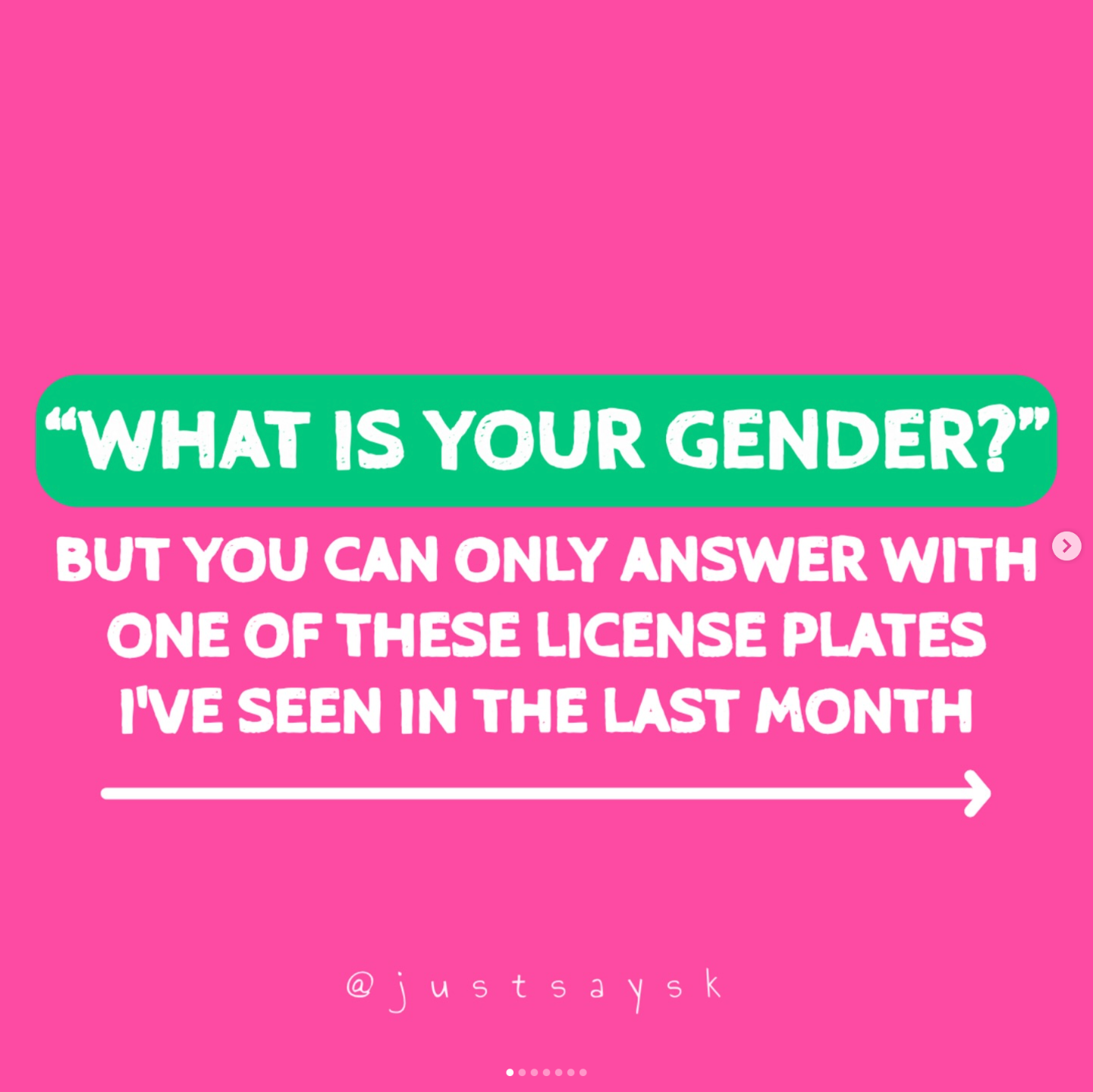
Jess Romeo: Yeah. Yeah. There's gotta be joy at the revolution, right? Now, which is your favorite series? Because I'm a little bit stuck on the new non-binary names dropped additions or the name your gender, but only through license plates or t-shirts. Do you have a favorite? Because I love all of
SK: Yeah, no, I definitely, those are all just like just for fun ones that I've done, like the license plates. I have the whole family now, like my partner's daughter and my partner will like look for license plates for me and take pictures and send them to me. And people are like, do you find these online? And I'm like, no, I literally, they're all the same state. If you look at them, I just take those pictures with my phone. It's just for fun. Again, like I said, it's lighthearted. So I do like to do those ones and like I'll do ones where I go to thrift stores and take pictures of different shirts and be like, your gender. Those are just to bring joy, but I think my true favorite is my erasure poetry, which is taking the hate that I get, screenshotting the most interesting and nuanced ones, maybe the longer ones that have a little more meat to them, and then letting, it started as just me, but then letting my followers also transform them into poetry and messages of love for the queer community. That brings me the most joy, for sure.
Jess Romeo: That's really great to know because it does feel like the piece of your content that goes the deepest, that is the most impactful to so many people. Do you remember the first post you got? Do you remember how that started?
SK: the first post that I turned into a ratio poetry.
Jess Romeo: Yeah, the first post that you turned into a racial poetry. Why? How did that come to you?
SK: Yeah, sure. So I had seen Erasure Poetry from many other people for many years. I studied Erasure Poetry in college, so 10, 12 years ago. I also remember somebody let me borrow a book, I believe it was by Kate Bear, and it was Erasure Poetry from anti-feminist emails that she had received. So I remember that was the first thing that sparked for me We don't just have to make erasure poetry out of found items like pages from a book or whatever. It can almost be this like revolutionary act of creating love. So I took that as inspiration and I remember going through my feed that day and finding dozens of, you know, hateful messages and saying, maybe if I just do this as a- Personal practice this will help me because at that time I didn't have a way to navigate the hate comments I was receiving So I decided I would do it for myself and once I had an album on my phone literally just for me to reflect on and look at I had about 40 and I said Maybe I'll just take these and share them sometimes and other people will find the same sort of joy out of it that I did I did that for about a year and it did so well that I then invited weekly submissions for other people to submit a their poems and actually take part in it as well, which is what it has evolved into and has become a consistent series on my page.
Jess Romeo: It really is a beautiful series and I think I did pick a post on your page just to kind of show listeners because they're not necessarily going to be looking at your page. And one you did recently is, is not quite as hateful. So I don't really have to give a strong transphobia warning. Some of them are much more hateful. This one's on the mild end. So this is an example of what the hate erasure poetry looks like. So the original post says, this are actually, wait a second. First, I would describe. the sort of the slide where you describe what it is. So on SK's page, they say, every so often I choose a particularly interesting hate comment from my page and offer my followers a chance to turn it into poetry and the ultimate act of self and community care. Here's the beauty they created this go round. So we've got the original post says, I think the main point is why do kids need to choose an identity? Can't they just be kids first and foremost? We wouldn't tell a kid they are gay if we thought they might be when they grow up. We can show them love and let them figure themselves out. If the medicalization of children wasn't on the line, I would be for the pick your own gender idea. But no minor can consent to being sterilized and being a lifelong patient. So that's the original hate comment. And the responses, the first one here on this next slide says, the main point is love. I think the main point is, why do kids need to choose? Can't they just be kids first and foremost? We can show them love and let them pick their own gender. And then I'll just do one more. The main point is, kids need love, let them be.
SK: Right. It is. And I'm glad you chose that one. I wanted to say that specific comment that I chose actually got mixed feedback from my community. I had people who usually really liked the series say that that comment specifically wasn't hateful enough to be chosen for this series. yeah, it was a more mild response. And it actually probably came from someone who was more ignorant than they were hateful. And I reminded people in the comments during that one that not every comment I choose is one that is directly rooted in like hatred and just like nasty words and language. Some of them really are just taking a misunderstanding and creating something more understood. And I just wanted to mention that because I do think there is an important distinction between hate and ignorance, but they're called hate comment erasure poetry, because I've had this series for three years. So it's something that, right, but this could be someone who came to my page and has never seen this before and was like, that's not a hate comment. But it is interesting, even from the people within the community sometimes have a strong or visceral reaction to this, to this love, and this like recreation. And I think that's valid. And I think that's a learning experience. I tend to receive a really large amount of hate and death threats and really, really bad stuff on the internet, but I've opened myself to that knowing it's a possibility as a creator. And then there's people who receive this by scrolling through their feeds who've never received that personally. So it can feel very victimizing personally to folks. So it's an interesting practice to allow yourself to open up to this hate and see what you can do with it. But I'm glad you chose that one, because that one got some interesting feedback on my page.
Jess Romeo: Mm-hmm. And it is it's just incredibly thoughtful the way that you have Curated it because you do have that slide one is always an introduction to what this is slide one never has The actual hate comment on it so people could see it in their scroll you get to opt-in so like just Consent and art and beauty and love. It's just all over. It's yeah, I'm obsessed anyway, How has I would imagine that You know, even with this really nuanced upbringing, like you've got the foundation there to be able to sit with all this with resilience and community. But I imagine it gets really hard sometimes. Like, how do you cope when it gets really bad?
SK: Yeah, I think particularly in the last month it's been really bad. If you've been paying attention, you know why. Yeah, for years, I'm approaching four years on the internet sharing in the way that I've been sharing. And progressively over time as my page has grown, it has gotten heavier, it's gotten more serious, it's gotten nastier. But with that, I've grown and I've learned how to cope. It was not always easy. It is not always easy. But I think that these these chances of creating art, these chances of involving community and circling it back around and making it something productive is what keeps me going. When I have particularly hard moments, like in the past month or so, I lean on real life support. I have an amazing partner. I have a wonderful community at the yoga studio I work at with my mom, with my family. So I unplug and I connect, which is a really important thing that everyone should do no matter what kind of self-internalized hatred or messaging or external hatred and messaging you may be receiving. You do have to stop and reconnect elsewhere when it gets overwhelming.
Jess Romeo: Yeah, you absolutely have to and like as a mental health provider, one of the things that I know is that stress can actually make us social. Oxytocin is a stress hormone too and there are, so there are some kind of inborn impulses there that prime us to seek out support and connection in times of stress.
SK: Sure, and I think that's a protective measure that's innate to us that allows us to continue. I think some of that is very unconscious and I've noticed it myself. I mean, I tend to be pretty, pretty introverted and I like that a lot of my queer communities online because I can turn it off and like be alone and read a book when I want to and I don't have people calling me and like showing up at my door to hang out. I've always, I've loved that, but I've noticed that my lack of in-person community in the last month or so has felt detrimental. And I'm getting this like innate sense of like, I need to organize and I need to build right here in front of me, which I've been doing. And it's felt protective and like a safety measure to give myself.
Jess Romeo: Mm-hmm. I'm glad you're doing that and that you have that. It's incredibly important right now. Anything else that you would want to say about the current environment? I don't want to harp on it or focus on it too much, but if there is anything important you'd want to say, I want to give you the opportunity to.
SK: I think people need to hear it's okay not to have answers. I think it's important for people to hear that nobody actually knows what's next. Nobody has the answer. There's no one you'll turn to on social media or media in general who's going to give you a perfect plan or layout of what to do to feel better. We all feel confused. We all feel hurt and lost and a variety of emotions that also include hopeful and strong willed and clear in our community. And I think that mix of emotions should all be housed in you and you don't, you're not behind if you don't have the answers and you're not gonna be left behind or lost if you don't know what's right for your next steps. I think it's been an interesting and unique position to be in. to have people looking at me for answers when I'm looking at everyone else for answers too. And it's made me realize that the people you see online are just people like you. And we're all very much on the same field in it together. I think there's solidarity in that rather than having this hierarchy of people who we can look up to to know what to do next. We're all right there together.
Jess Romeo: Yeah, we are. And as long as we stay there, I feel hopeful for the future as well. Not sure how long it will take for us to get where we need to be, but yeah, I see that. No, because I think certainty, that's part of the problem. No, no, no, I saw this growing up. My upbringing was a little bit different being in the South. I was maybe more influenced by just Bible Belt. kind of, um, and that was really pervasive where certainty was an oasis that people really seemed to need in the face of chaos where I was always there just asking, but wait, why, why this doesn't make any sense to me. Um, so I think that's, that's an important reminder that the desire for certainty isn't a political affiliation. That is a human drive to need to tell a story. Like when anxious and we don't have data, we make up stories about what's happening. And as long as we know their stories, like I know that I like to understand the water I'm drowning in. That is how I cope. I read books, I try to understand, but I know at the end of the day that I'm not gonna have the answer.
SK: Yeah. And nobody is because we've no one has lived this exact moment in time before. And that's okay. It's okay that no one gives us a playbook. We get to write it. And I think that that can be a really powerful thing that people maybe don't quite yet have the fire in their bellies to get to because we're still thrown back from what we've been hit with. And that's okay. We're going to get it. we're we We're gonna be okay.
Jess Romeo: Yeah, still trying to get back up. Yeah, that's okay too. Yeah. I mean, in that way, we've never been here before. We don't know what the future looks like. So it's going to be a pretty queer revolution in that sense of queer being this combination of creation and defiance that's just uniquely us.
SK: Right. Yep. I think it's really cool that I think about how at all times this is true, but specifically right now when 50 years from now, a hundred years from now, people are reading about this time, this is a revolution. We're in it. And whether you see it, we are actively participating in it. Whether you're at home talking with friends and organizing, whether you're running a GSA club, whether you are having a queer book club or making art or infographics online or Just calling your local representatives, whatever small little thing you're doing, it's going to go down in history as something that has contributed to a larger revolution that we're all taking part in. So no person is too small to make a change. No day by day action that you're seeing unfold is small in the face of what we're facing. It is building. We will teach about this time in the future. And I think that that's a really cool thing to be a
Jess Romeo: Yeah. Wow. Like it's, it's rare, I think, because I've met a lot of people through doing some of this work and you know, you've got about 130,000 followers. So, you know, there's this way in which we can see people online and get a little bit starstruck, which is always funny to me because I'm just like, well, they're just a person, right? But people don't often live up. To that, they're not always an accurate reflection of some of the stuff they post. And my God, you are like, this is that person. Like you are this person who honestly, you do feel like this lovely hybrid of politician, lawyer, like yoga studio creative dancer. And it's all just queer, all infused with queerness. Like it's just really cool.
SK: I'll take that. I think that's what I was born to be. It's a really interesting thing. Like I'll look back at my childhood and be like, if I just had like really open, queer, affirming and discussing parents, like I might have like not fought so hard to be this person. And then because of that, I might have like not been able to harness the community I did. I think that everything really did lay out in a very specific way for me. to be able to be the person that I am, but I appreciate you saying that you can see the authenticity in it and find the duality. I think that's what I hope to be.
Jess Romeo: Mm-hmm. Yeah, no, it's absolutely there. Well, I know, we're actually fairly decent on time, but I want to respect yours for sure. Are there people, like artists, creators, who've shaped the way that you sort of see gender, humor, storytelling, that have shaped your content?
SK: For sure. I actually took it upon myself to create a group chat on Instagram of all the creators that I've looked up to, people who do similar work to me. And I literally just was like, let's be a little delusional and bring everyone together and be like, I like you all, let's create a space to chat about what we do. And everyone was so responsive and so beautiful and wonderful. So I have this really strong group chat of people. I'm happy to share some names and such with you that you can attach to this podcast if people want more resources. But there's a lot of people. But just people with different perspectives, all queer, who now are very much supporting one another's work and creating a stronger network that has influenced all of our work really beautifully. So without giving you specific names, yes, lots and lots of people that I can send you lists of for other folks who investigate and kind of see. But also if you just scroll through my Instagram, I've done a lot of collaborative work with different people. They're all tagged. You can find them all pretty easily.
Jess Romeo: Yeah, no, I'm sure we'll put all the links to all the things, Paige. Well, I think about like a younger version of yourself because I sort of tell this story to myself of, okay, dance, there was a lot of freedom in that, especially with neurodivergence. I didn't say this before, but this duality in the way that dance can be a language in a form of expression that they're actually. is a lot of authenticity in. I know so many people that are like, spoken English is like my second language. I really wish that I could express a different way. Are there ways that you sort of played with gender when you were younger? Like were you doing kind of fun things with stuffed animals or doing interesting things with dance that didn't get suppressed by the environment around you?
SK: Yeah, in a weird way, dance, like I said, in the classroom was extremely binary. In its practice is extremely binary. So when I was training and training and training, I was taught how to be a female and how to be a good female dancer. But when we're on stage, all the rules go away. So you fight so hard for these few moments where you're in front of an audience and you can play anybody. So I wore wigs, I wore dresses, I wore suits, I wore animal costumes, wore beards, I wore curls, I wore pearls, I wore everything. In like the same year I was 13, I played both Peter Pan and Belle from like the Disney Princess. So it's, and I was praised, right? When I'm Peter Pan, you need to be young, you need to be spunky, you need to be masculine, you need to be mischievous. And then literally three months later, you're a princess, you're an ingenue, you're soft, you're feminine. And not only am I praised for portraying these qualities and showing the differences, people are paying and buying tickets to watch me do it. So it's this weird, like, when you're in the classroom, I felt so stifled and I literally grew up in front of a mirror, which it has its own, you know, body image and the way that you're perceived and the way that you're close-fitting and the way that your hair looks. Growing up being perceived as a girl, who would be perceived to be a woman when she got older, that had mental health effects. And the binary pressure of being in that technical space also had mental health effects on someone who was trying to understand their identity. But those few moments you get on stage where you're literally, everyone's depending on you to play this role of someone you're not was so freeing that I like was addicted. I think that's why I just could not leave. the dance world, even though the moments were few and fleeting, in what other stage, like in life, are you able to be told to be different people every day and praised for it? So that was like a really creative space and playful space for me. So I still am unpacking all of that, have mixed feelings about the way that I was raised in theater and dance, but everyone I've talked to who's neurodivergent or queer who grew up on stages. has similar dueling feelings.
Jess Romeo: Mm-hmm. It is definitely true, and this feels like almost a more simple yogi-bera-ism kind of paradox that pretty much everything we go through is more than one thing. You know? And that's useful to remember right now.
SK: Yeah, for sure. For sure. Yes, it is.
Jess Romeo: I'm curious what you would say, not just to cis people, but also just to a sort of binarized culture that we grew up in. What do you think people get wrong about gender exploration? Have you seen folks overcomplicate it or just, yeah, what do you think people get wrong?
SK: really interesting conversations with my mom about my childhood. And I think that we come back to a similar point every time. And I've had it with some people online too. And I think we got to start really, really young with this conversation. I think that there is a wave of parents today and some parents from our generation, but parents now millennial parents who are very pro my boys can do anything. If they want to wear a dress, they can wear a dress. If they want to go to dance class with their sisters, I let them. Like very fierce advocates for that. And they'll say the same thing about their girls. You'll see it online too. Like videos of parents so proud of their little girl riding a truck through a mud pit and they're like, I'm raising the best well-rounded little girl there is, right? And that is a really almost to the point idea that thank you for trying. Thank you for doing what you believe within your binary system is best for kids by being open to the idea. But we're still missing the point, which is that I tell people and I've told my mom, you shouldn't have what you perceive as a boy, which is a child who was born with either XY chromosomes or a penis. or whatever it is that you're considering boyhood and say, it's okay if you like girl things. You shouldn't do the same thing with a girl and say, it's okay if you like boy things. What we should be doing is having babies and telling babies that they can like baby things. Have a toddler, tell your toddler, it's okay to like things, to do things, to wear things. And maybe that's just a language thing for people, but it's so much.
Jess Romeo: I was going to say, do wonder if it's a language thing, because I know a lot of parents who the mindset feels expansive, the language we have to describe that behavior and what we're okay with is binary and restricting.
SK: Because it's still labeling things right? The messaging is positive to tell a little boy who wants to wear an Elsa dress, you can wear an Elsa dress. It's okay for boys to like girl things. That is a positive evolving language that is good. It's on the right track. But instead to be very mindful of our words and say, you as the name of the child are allowed to like Elsa. doesn't gender the clothing, doesn't gender the child, and doesn't gender the activity. So there's no need to then deviate in the future and say, well, this son that I thought I had who's been dressing like a girl is now identifying as a girl. It's just my child became who they are because I never labeled things or activities or places or people or events or likes or dislikes. It's going one step further. is the most important work you can do and just not labeling things that don't need a label.
Jess Romeo: Yeah, a hundred percent. You might help me. You might be able to help me extend this metaphor and improve on it a little bit. Cause I've been trying to figure out ways of describing, like any good mental health provider, I have tons of metaphors for stuff, but thinking about binary gender, what I was telling someone recently, it's like, okay, when we're still kind of stuck in a binary mindset, it's like assuming that gender, it's like a theater show where you have a ticket and you have an assigned seat. and that in order to sit in a certain seat, you have to be able to show your ticket and say to that person there, I'm sorry, I think you're sitting in my seat. Like I need to sit there. But that's not what it is. Like there are no tickets. There's not even really any seats, but it's more like going to a movie where you're not, there's nothing that's assigned here. How would you improve on that metaphor or change it a little bit? Or do you feel like it's good?
SK: That is good. I haven't heard that one before. like that. yeah, to kind of make it seem like we're all going to see a show and instead of being assigned a ticket and then trying to find your seat so that you are following the rules. At a movie theater, everyone still follows the flow of entering, exiting, being respectful. They just no one expected anyone to sit anywhere. So no one's wrong. If you don't place an expectation on a person to do something, No one ever has to deviate or explain themselves or make a different choice. They just are and they just they just be. And I think that's what we're trying to get at with gender. And I think I hear the opposition of like kids, even the the hate comment you mentioned earlier. Why can't kids just be kids? Why are we choosing genders for them? Exactly. Why can't kids just be kids? Why are we choosing genders for them? And it's not to make children, non-binary, it's to make all children exactly who they are without us guessing and then them having to say yes or no mom five years to 10 years to 20 years later.
Jess Romeo: know exactly it's if if it were if we were able to reduce the expectations and queer and trans people were safer just at baseline then it wouldn't feel like such a high threshold and a high bar that we have to cross and there's a there's a lot there about just the medicalization of trans identities and all of that but I really love that frame yeah we all know what to do in a movie theater just the flow
SK: Yeah. And everyone does what they need to do. And we don't judge anybody for choosing to sit closer or farther away. Everyone has a different experience, different things that they enjoy, and they do what they need to do to watch the same show. But we're all watching the same show.
Jess Romeo: Yeah, it's about the show, not the seat. OK, that's really great. Let's see. I was going to ask about how you started, because we talked about this last time a little bit. Did you set out to be a content creator and create this following? Or how did this all start for you?
SK: Yeah, no, I had no intentions of being an online figure, of creating content. This was not something I had in my radar. When I shaved my head, like we talked about earlier, I think I was 22, 23 years old, and immediately, it's funny to look back on, I leaned really hard into like, women can do anything. Women can have shaved heads. Women can... Women aren't defined by their hair. Women aren't defined, you know what I mean? So I was like, yeah, yeah. So, no. And you know what it is? It's because I shaved my head and I looked in the mirror and I said, I'm not who I thought I was. I'm not the role I was playing. So I had this like moment of like leaning really hard into like super like binary feminism because I literally never heard the word non-binary before. So I was like, yeah, women can do anything. Women are. Amazing and diverse and that is true. But then I had a friend who in college Identified as a lesbian and then came out as a trans man and that was like the first time I had kind of heard that in adulthood and I watched his journey through top surgery Online and he just had like a personal account and just shared with like the very few people he knew like 500 followers or something and I remember being like that was so informative to me. That was so insightful and I learned a lot and I knew at the time, I'm not a trans man, I'm not a cis woman, but I never heard the word non-binary, but keeping all this in my mind, I heard the word gender diverse for the first time and I was like, my God, like that's me. And I was like going on like Tumblr, so at the time was like very end of Tumblr. I was looking at that, I looking at YouTube, big into YouTube, Facebook groups, just trying to figure out what that was, because that's where I felt like, I lied, found the non-binary community, heard that word for the first time, gathered as much info as I possibly could about it, and realized that's who I was. So I decided top surgery was something I needed to affirm that identity for myself and be comfortable in my body. And as I went on my top surgery journey of booking consultations and looking into it, every single person that I saw having top surgery was trans masculine or trans man was on testosterone, was having nipple grafts, was getting very binary placement using very binary language about the process. So I was under the assumption I could not receive top surgery and that that was not an option for me. So I grappled with that for about a year. And once I was like, no, like I really want this and I'll like tell my surgeon I'm a trans man if I need to in order to get this. That's what I thought for a while. And I went through that process and I said, you know what, if I just share my story the way that my college friend had shared with just his personal friends and family online, maybe I'll educate someone, like maybe one of my like elementary school teachers or my neighbor from like high school. You know what mean? Like someone will see it and like have an awakening and they'll just have knowledge. So I decided to go on a top surgery journey, very like no representation before me and share about it. So I had surgery in 2020 and I shared a daily highlight on my Instagram to my like 900 followers of my recovery because people were asking me if I was okay, what was up? Why did I do this? Are you a man? Like just didn't understand. So I was sharing as I learned and immediately my Instagram just like blew up from the hashtags I was using. I think I gained about 10,000 followers in a month. And I was like, what do I do? Do I allow these people to have these conversations on my page? Do I facilitate them? Do I make my Instagram account private because this is weird and I don't know these people? But then I realized it was exactly what I had wanted for people to find community to, it wasn't ever about me. It was about being kind of a facilitator for other people to build community. Cause that space didn't exist five years ago as far as I was concerned. So I allowed it to grow and At a certain point, I think around 25,000 followers, was like, I guess I'm doing this, and I embraced it, and it became more of an educational resource than just an experience sharing resource. And it's been five years, four or four and a half years, so here I am.
Jess Romeo: What are some of the biggest highs and lows of it for you?
SK: My biggest high by far is just the community. I always wanted one other person to find someone in me that they could relate to so they didn't feel like top surgery wasn't an option for them, but I never anticipated how many people I would relate to. And it very much, in reverse, I have 135,000 people in my phone that understand. I can't fathom it sometimes. I'm like, these people like... I don't really know much about them, but they're here. So unless they're like hate following me, like they appreciate, understand, have some sort of reference point to me. And that's been such a beautifully overwhelming thing in my hard times. And then the hard times go along right with it. never in my life faced as much hate and death threats and just the worst kind of humanity that you can find as I have being authentic on the internet.
Jess Romeo: Yeah. No, it's really hard. It's really hard when, and it's like people's inability to be free. Like I see the chains that people are in with all of that hate. And I know you do too. That doesn't mean that's the first emotion that is salient every time you come across it, but it's just, it makes me sad more than anything. Really.
SK: And you know what? It usually is. That usually is the first thing I feel. And I think it's because my dad passed away two years ago. So we never really got to get to a point where I could fully be authentic and he could understand me, but he did try. And when I see people who mostly are rooted in ignorance, but it comes across like hate, I know the world that they grew up in. I know the parents they had. I know the messaging they received. I know the media outlets they listen to that were in their houses when they were growing up because me too. And if I wasn't non-binary and trans and queer, maybe I would be like them. And they're maybe not bad people, they just don't have resources or information or understanding to be empathetic people. And my job on this earth is to be a positive example of someone who will not attack them back. And if that is enough of a seed to plant to allow them to one day revisit the interaction and think maybe I wasn't so bad after all, that's enough for me. But yeah, it's generally rooted in they just don't have the life experience I do, so they don't know better.
Jess Romeo: Yeah, no, I can really relate to that. That was one of the things that felt incredibly resonant as I was growing up. Like my queerness was the reason I was asking questions. And I had a profound respect for the fact that people around me who just were able to fit in, like why would you? You know, so many things about this, they just work for you. There's not really a reason to. And so I can't, yeah, I can get that too. Resentment comes at times, but that's also human. Yeah.
SK: Sure, it is, it is. And it's, I'm not a perfect practitioner of receiving a hate comment and saying, they just don't know better, delete, make love out of it. Like most of the time, yes, I'm at that point, but there were times where I would spiral and I would be like, why are people like just coming at me? I'm just posting a picture in a dress because I like it. And they're like, they cannot fathom. that I'd be, and it comes down to, it's in person too. I've noticed it sometimes in a small town, which I'm just better at now. When people stare or they have something negative to say, they just are uncomfortable with your joy most of the time because they can't fathom living so far outside of the boundaries they were told exist that not only would I do it, but look joyful while doing it. It just breaks their world a little bit. So I just have to remember that me breaking their world can make them in the moment uncomfortable. But over time, it opens your mind. And maybe I don't see the fruit of my labor, but I know that I've started that process. And that's enough for me. Most of the time. Sometimes I'm mad about it, but that's just me being a human. Yeah. Yeah.
Jess Romeo: Yeah, that is being a human. Yeah. I like how you act. Maybe, maybe, maybe not accidentally kind of stumbled into very, what feels like intentional nonviolent resistance in the community on your page.
SK: Yeah. Yeah, it's intentional for sure. I think that, again, if I didn't have the upbringing that I had, I wouldn't have that approach. I think I'd be angrier. But I loved someone and I still love someone very deeply who was misinformed and had very different opinions than me. And he was not a bad man. He was a great man who wasn't queer and didn't live the way I lived. So he didn't know. And those people walk the earth and their fathers and their brothers and their sisters and their siblings and spouses. And they are also good people who just have bad opinions or misinformation. So that helps me. We have more in common than we have different. And if we treat people that way, we get closer to actual liberation.
Jess Romeo: from both ways actually. And so I've been thinking about this recently as people have talked about like the current president and any leaders who are autocrats or wanna be autocrats that we actually forget the humanity of those people and the average just ordinariness of those people. So I think, you when you say things like, I loved someone who was very different from me and we could still make this work and he's human. think that doesn't only breed nonviolence and peace, but it actually helps us to resist wisely and notice threats when they exist because it's not a one-note Disney villain. It's not a Bond villain or a monster that we're looking for. We're looking for like humans cause this harm. So I think that's an important point too about that.
SK: Right. It is. And it doesn't excuse the bad things that those humans do, but it does give you, it should give you pause to recognize that they are just humans. And humans have a vastly different approach and understanding to the same experiences that other humans have. And when the humans who have vastly different approaches and experience than you do take power over your life, that's when there's intense conflict and issue. But it does almost ground me and bring me down to earth to remember they are just humans. Those people that we're so terrified of, that are causing such real life harm, are human beings who have nuance. And we have to like, not overwhelm ourselves, not completely panic and remember that we're powerful in numbers and we have calmness and groundedness within us even in our most chaotic of times.
Jess Romeo: Yeah, we absolutely do. Well, I want to get to, so I usually have like one more question and then toward the end. So I'll ask this next question and then talk about the kind of end part because I'm excited about this. If the Internet suddenly disappeared tomorrow, what's the legacy that you want to leave behind? What's a message about queerness, gender, play, however you would describe most of the essence of what you do? What would you want to leave people with?
SK: I want, I would want people to know that they can absolutely choose their own path. And my journey was born from not having the representation to show me that. And all I ever wanted to do on the internet was be the representation to show people that a different approach, but the same message. You can be your own guide. You can forge your own path, whether that's gender, sexuality, identity, pronouns. religion, spirituality, it doesn't matter. Every single person on this earth is different in all of those things. There is no box. There is no requirement. You can be exactly who you want to be and that is enough. And I just hope people saw that in me and they don't have to be like me. They don't have to dress like me, look like me, act like me. But I hope that they see that divergence. is okay.
Jess Romeo: In it's pretty badass. We definitely do. So I usually end with, you know, asking about something that's giving people really good queer or trans joy. So I'd still love to ask you that, but you get your own special ending to this. That's a very on-brand just say, SK.
SK: Yeah, we need more of it. Okay. Okay. You still want me to answer the question? Okay. Yeah. I think currently, my attempts to make in person connection is some clear joy for me. I have been going out of my way. I work at a yoga studio. Everyone has been wonderful there, but I've gone out of my way to be very open about my identity. when usually I just exist and if people assume they assume and if they don't they don't. I've corrected myself or I've corrected people on my pronouns, my identifying language. I've led almost inclusivity training for the staff, volunteer. These are things that put me outside of my comfort zone that usually I would panic about, but I feel strong about doing them and it fills my cup to be able to offer that for people. So that's been a really joyful thing for me recently.
Jess Romeo: That's really lovely and again in-person community. We really need that right now That's great well the ending that I have for you is a bit reminiscent of Non-binary names just dropped if your gender could be this what it would be so there's a lot of different options here And I'll ask them all and if something doesn't resonate or you're like I don't know we can just skip it because there's a lot of options So let's see, we've got, your gender were a weather pattern, what would it be?
SK: I've actually done this before on my page. I didn't pick one for myself. If my gender were a weather pattern, I would want to do that like rain shine. You know, when it's like sunny and raining, but before the rainbow comes out, I think that that's really beautiful.
Jess Romeo: Rainshine, okay, again, duality. I see this, okay. If your gender were a type of food, what's on the plate? Are we a chaotic charcuterie board? Are we a well-composed dish? What are we?
SK: We're like some sort of like plant-based like salad bowl, but we got all the colors. There's like a little bit of everything, lots of different textures. It's a little crunchy, a little bit smooth, nice dressing, a glaze maybe.
Jess Romeo: Mm-hmm. Yeah. Oh, yeah. It's like you gotta have a dressing or a glaze to sort of pull things together. Yeah. Okay, I like that one. What about if your gender were a piece of furniture? What would it be and why? I guess it doesn't have to be why. Yeah, if your gender were a piece of furniture, what would it be?
SK: My initial thought was like one of those like three tiered lamps with like the different colored heads. I don't know. I don't have an explanation. Just that.
Jess Romeo: Yeah, yeah, okay, no explanation needed. What about, let's see, if your gender were a celestial body, where would it exist in the universe? Planet drifting between galaxies, yeah. Like yeah, planet drifting between galaxies, a star that only shines sometimes, a black hole, like we got endless options here.
SK: Nice, I would want it to exist somewhere that hasn't yet been discovered.
Jess Romeo: make sense. Yeah. Mm-hmm. There are more, but I think that's a really good one to end on actually. Somewhere that's never been discovered. Well, thank you so much for taking the time. This was a conversation I didn't know that I really needed right now, and I think it's one that a lot of us need. So thanks so much.
SK: Yeah, you're welcome. I feel that way too. So thank you for chatting with me and giving me a little more virtual, but face-to-face connection that I need as well.
Jess Romeo: Yeah.


About your host:
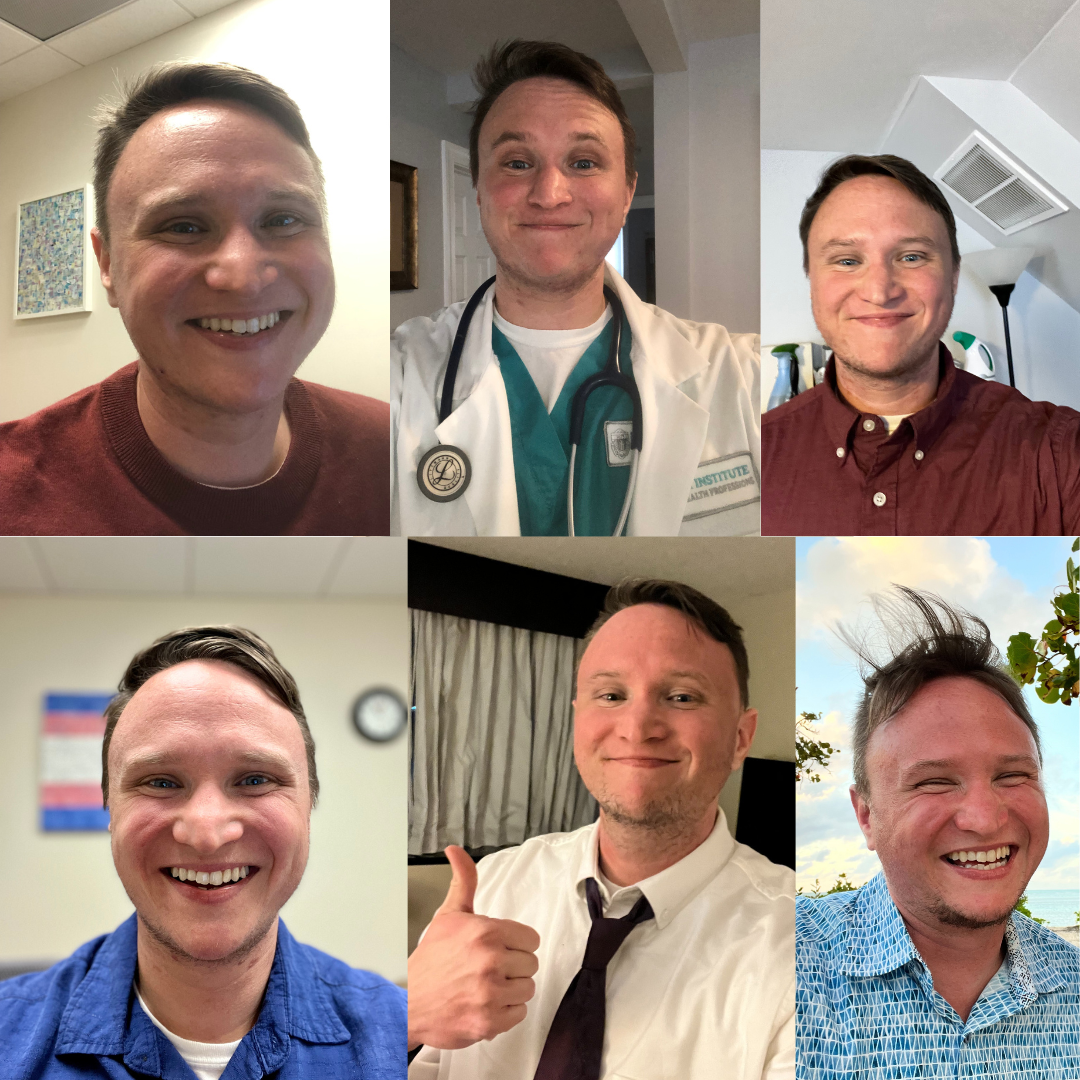
Jess Romeo is a Psychiatric Nurse Practitioner, clinical social worker, mentor, and educator with a passion for making gender-affirming care more accessible, inclusive, and informed.
With years of experience seeing patients, training healthcare providers, and being queer & trans, Jess brings a nuanced, compassionate, and engaging voice to conversations about gender identity and social justice.
Through this podcast, Jess cultivates a curious and brave space to explore the realities, challenges, and triumphs of our lives—helping providers, allies, and community members reflect, deepen their knowledge, and take meaningful action.