

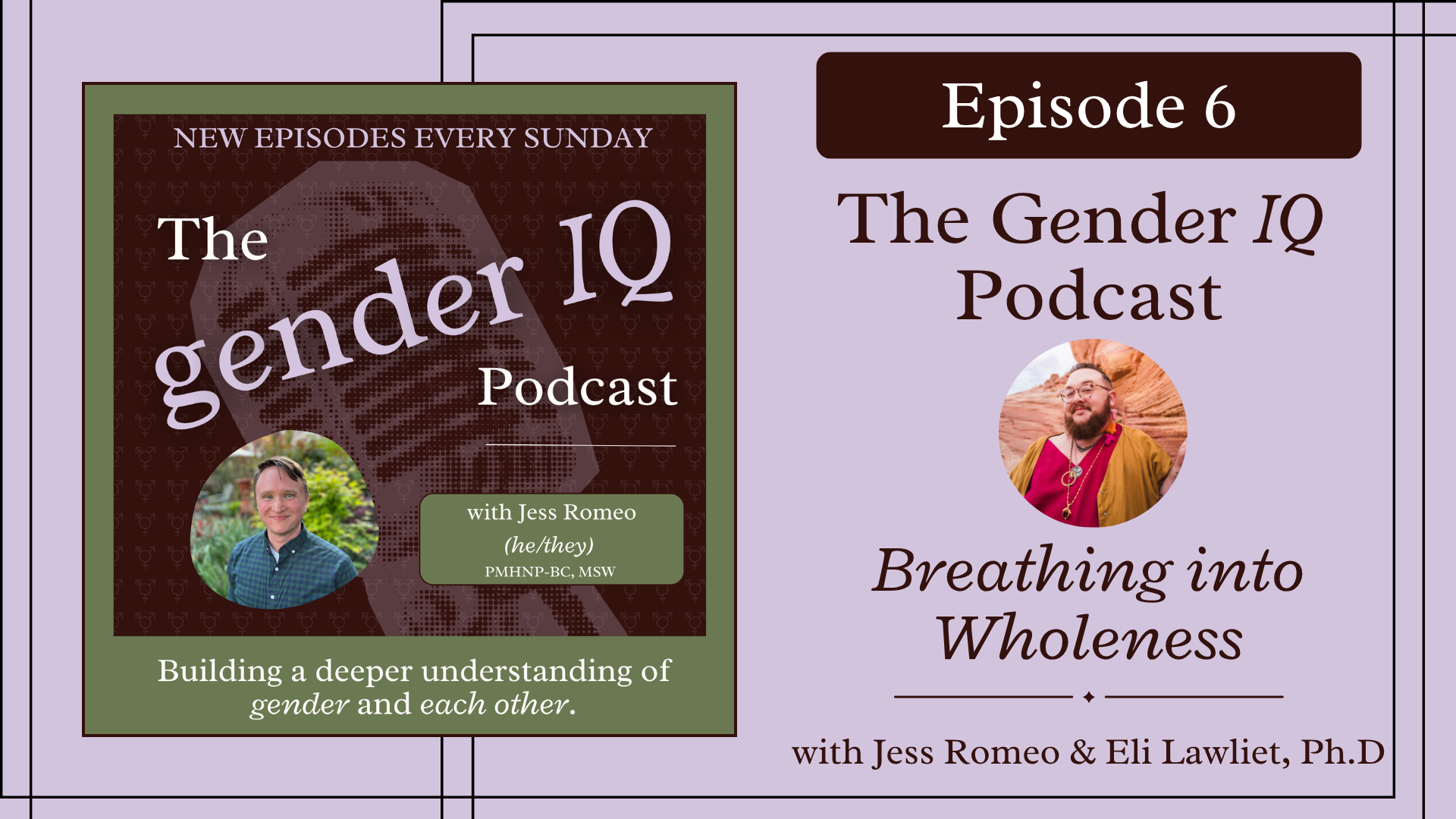
Episode 6: Breathing into Wholeness
Episode Overview:
In part two of this conversation, Jess and Eli explore the origin and evolution of gender doula work: what it is, why it matters, and how it changes lives.
Blending history, healing, and spiritual care, Eli offers a deeply human alternative to the gatekeeping and rigidity so many trans people face.
Together, we discuss:
✨ The colonial history of “true transness” and its lasting impact on care
✨ Why certainty has become a requirement—and a trap
✨ What it actually means to be a gender doula
✨ Making space for grief, joy, and the parts of transition no one prepares you for
✨ Breathwork, embodiment, and tending to the nervous system in trans community
About the Guest
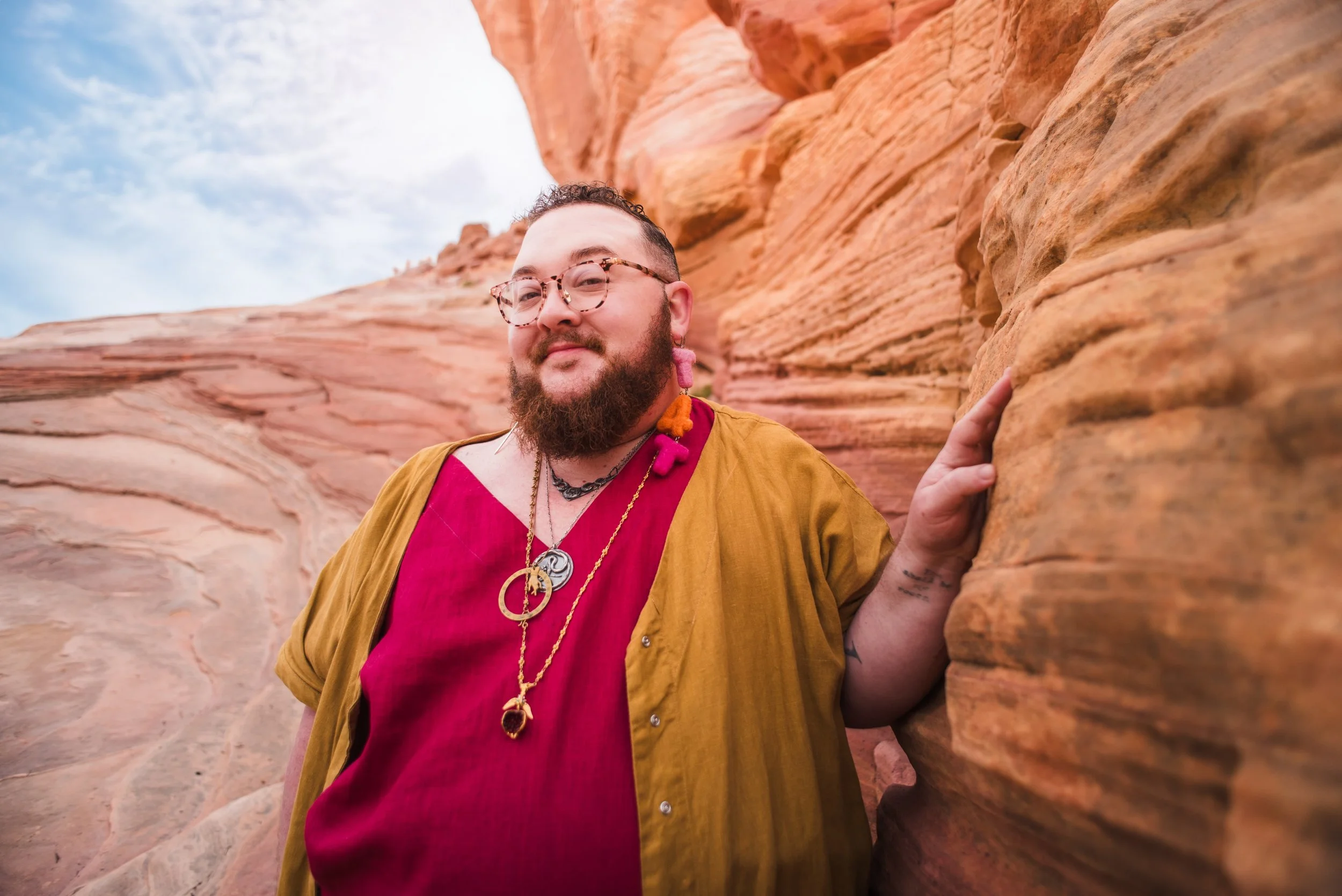
Eli Lawliet, Ph.D., (he/him) is the dreamer and weaver of The Gender Doula. In addition to a decade of experience researching trans healthcare, law, policy, and history, he has formal training as a full spectrum doula, breathwork facilitator, and tarot reader, as well as many years of surviving the world of poverty wages and retail work. The broad scope of his experience directly informs the equally broad spectrum of his work as The Gender Doula. Eli has been seeing clients since January of 2020 and has worked with hundreds of trans folks nationally and internationally in sessions, classes, and workshops. Though he was born in Oklahoma and raised in Missouri, Eli currently lives in Los Angeles (Gabrieliño-Tongva, Chumash, & Kizh land) with his partner, three cats, a dog, and four snakes.
-
Jess: Welcome to the Gender IQ Podcast. My name is Jess Romeo and I'm a psychiatric nurse practitioner, psychotherapist, and just an endlessly curious soul. I'm also a trans guy who specializes in working with queer and trans folks every single day. In my private practice. I created this podcast because in a world that seems hellbent on using gender identity as a wedge to divide us, I wanted this to be a space for thoughtful, unfiltered, and nuanced conversations that. Help us connect with one another. If you're a healthcare or a mental health provider like me, this can help you better understand the complexities of gender identity and support the needs of your trans and gender diverse clients. And if you're a fellow gender outlaw, you might find some of these conversations empowering and helpful to your own journey. But for everyone, I want this space to be a place that showcases playfulness, complexity, and just the messy humanity that we share within a topic that too often seems serious and divisive. So wherever you are on your own journey. I'm glad to have you here. Let's dive in. As we're on the note of kind of a consent process and tuning into what your body is saying, tell me a little bit about some of the work that you're doing in like your breath work circles for trans liberation. I was looking at your website, looking at your Instagram being like, all these things that he's offering. How do these circles and groups work?
Eli: Yeah. Breathwork, I have been working on getting breathwork certified as a breathwork facilitator through Breath Liberation Society. And that process is like a multi-year process. I. And so sometimes when people are facilitating breath work, they maybe went to a weekend training. That is not the case. Yeah. Like I very specifically, I knew that I wanted to get trained in a somatic modality because when I started doing this work with trans people, I realized A, how much were. In general very separate from our bodies and very dissociated. And B, how much information our bodies have and how helpful and useful it is to be in, communication with them for gender exploration and transition. I. And and then see that like most people who do somatic work with trans people don't understand the intricacies of doing somatic work with trans people. And that I had a lot of innate knowledge about that just from working with people, but would really benefit from having like a. A actual skillset that was curated through training. Yeah. I found Shauna, who's incredible, and I found Breath Liberation Society, Shauna's, the person who started Breath Liberation Society. And I've been learning with her for about two years now. And I. Breath work is a really powerful modality because A, it carries a lot of the same benefits of meditation. It's often referred to as a type of meditation, but it doesn't have the same thing that most of us associate with meditation, which is I have to be very quiet and not have any thoughts. Right. Which I do think is like a misunderstanding of meditation. Yes. But I know that, right? Yes. Must say a
Jess: misunderstanding.
Eli: That is a misunderstanding of what it is. It is, absolutely. But it was also my misunderstanding, right? Yes. Like I many years, I was like I can't meditate, I can't stop having thoughts. This brain never shuts up, yeah. There's
Jess: nothing much more Western than we must do it at the most perfect level, and B, yes, exactly. Absolutely. No more. Based between thoughts? Yes. No thoughts. No,
Eli: exactly. Exactly. And I will say that a lot of like meditation and mindfulness practices that I've built over the years have helped me tremendously. So this is me describing my misunderstanding. Yes. And how that impacted me. Fair though. But given that I had that misunderstanding, it was very helpful for me to discover that there were forms of active meditation and breath work is a form of active meditation. So I discovered breath work when I was. In kind of one of the worst parts of my chronic illness journey. And I was attending a breath work class held by Amy Ky, and it was called Breath Work for Bellies, and it was for people who were having GI problems. And like it was so supportive to just do breath work and a group of people who were all having bad, like struggle bellies. Yeah. Like struggle bellies. That's so good. It was yeah, it was so helpful. And actually, interestingly enough, like that class also started in early 2020, and so like ended as, we transitioned into the pandemic. And so having done that myself, I could see okay, I'm doing this gender doula work. I've done this breathwork stuff like this is very powerful. Breath work allows you to move energy and it allows you to do things in the body. Without having to consciously think about it, yeah. So you can work with the parts of you that are traumatized or you can work with stuff that needs to get, shifted without having to re-traumatize yourself through talking about it, for example. So that's one thing I love about breath work. I also just love the amount of energy that can move in the body with breath work. And I love the fact that breath work can do so much for our whole systems. Whether you're looking at it from a more spiritual perspective or if you're looking at it from a purely physical perspective. Breath work does many positive things for the body. It allows us to. I don't know. I don't want to go on and on about it because I don't have a citation per se at this moment. But Jennifer Patterson is an author who's written a book called The Power of Breath Work and covers a lot of this in a lot of detail. But yeah, so it's a really powerful modality and I found it to be a really helpful thing. And you can also, adjust it to many different levels of ability. And that's also helpful is that if someone's I have like this access need or this ability situation, I can adjust breath work to basically anyone, and so I've been working on learning it and getting better at facilitating it for almost two years now. And breathwork for trans liberation has been my. Offering this again this year. As I have made resourcing my theme. Breath work for trans liberation is a space where I specifically am like, Hey, all the anxieties that cis people have about trans people, those are not here. Like those are somewhere else. They're not this bubble. We are allowed to expand into our transness in the biggest possible way without thinking about what any cis person has to say about any of it, and so like we only talk for maybe 10 or 15 minutes of those sessions, but. That 10 or 15 minutes is so powerful every single time of just people sharing the most incredible things. And I'll usually have a little question or a prompt, and then people respond to it. Then we set intentions and then we breathe. And it's very simple, but it's incredibly powerful. And every month I feel like it gets more and more powerful and yeah. Resourcing, so it's been an incredible space. It's very open to beginners. If folks are interested and they want to join, but they don't know what breath work is, I teach you the breath pattern. I give you all the information, like it's very available to beginners as well as people who are more experienced.
Jess: Yeah. I think you're reminding me of how important it is to like establishing that container around any exercises like these, because I bet you know, for people who will listen to this, there are probably a number of mental health providers, maybe psychiatric providers who are here, and I bet you've taken someone through what box breathing is or what 4, 7, 8 breathing is and what it does for the nervous system and all that. But I think. What do you think about the importance of creating that container for the simple exercises and how others may be able to do a little, do that more skillfully maybe?
Eli: Yeah. Creating containers is a big topic for me. I work really intensely with containers in my own work. And that sort of increased over the years where like when I first started I had this idea of like I'm holding space for people. But then like over the years has grown into a much more intricate practice. So I would say one of the things is that if you're gonna create a container, for example, for trans people to be safe. You need to really think about that container in a way that is much more met at. If somebody joins my breathwork for Trans liberation class. They're gonna experience it as a really gentle, safe space where they can be who they are and where they can breathe, and where they have a lot of autonomy and that's how I've made it. What goes into making that a possibility is a completely different conversation, right? There's considerations that I think of in terms of. How do I advertise these things? What platforms do I hold them on? How do I keep people safe? What are the energetics of the space? How do I keep myself safe? Like how do I boundary myself? How do I boundary? Like we always open by doing what, I don't name it this in this space per se, but basically doing an energetic cleanse, a grounding, and then creating our own shields and then joining to one another mindfully in our energy, and then at the end dissolving those bonds so that we can all move forward in just our own energy and not carrying everybody else's energy with us. Yeah. So that's And the thought that has gone into crafting all of these cycles. And that's partially coming from Shana, my teacher and how she's taught me how to hold these spaces. But it's also a lot coming from how I've learned how to hold trans people over the past, like five years, that I've been doing this. So like it's. I think that it's really important not to just like doddle in and be like, I can do whatever with and with trans people and it'll be fine. Like you're looking at a group of people that is incredibly traumatized and under a lot of pressure and constantly like being bombarded with hate, right? If you're gonna hold space for people in that situation, you gotta be. Realistic about your capacity for holding the quality of space that needs to be done for folks who are dealing with that much every day?
Jess: Yeah, no, that's what one of the things I say in a lot of the trainings that I do is, this isn't rocket science and you need to know and think about this. More than you think. If this is something that you've never really done before, we need to really build a strong foundation. And it's hard because I don't want to create further access barriers to care, but I also think that I don't want people walking into a provider space where someone has been told they're ready when they're not. And I don't know, I think, we're recording this on November 18th. I'm not sure when it'll come out. But I think the results of the election are heavy energizing. They're a different adjective for different people, but I think a lot of providers especially are feeling motivated to try and do something and step up. I don't know. How are you feeling and how are folks in your circles feeling after November 6th?
Eli: It's all over the map. I will say I've been really impressed to see how many people are like, not just. Giving up automatically, right? Especially cis people, like trans people, we persist, and you can see that throughout our whole history and no matter what anybody ever does, trans people are just born all the time, so there's nothing you can do about it. Stop trying, it's boring, it's old give up. We are here and we're never gonna not be here, yeah. And so like that. Peace. There's a lot that could be said, but for providers and for cis people, I have noticed. I even had, bless their heart, I had folks contacting me after the election being like, can you mail me, like physical print resources that I can give out to my community? And I was like, baby, I wish I could like you. I don't have that, but I sent them to like P flag, but yeah. I think that it's been really heartening to see that people are interested in showing up, and I think that's one thing that is really fascinating about this moment, because a lot of folks want to compare this moment to other historical moments where trans people have been grievously harmed, right? On a large scale. And I'm not saying that trans people will not be grievously harmed at a large scale. I hope not, right? Yeah. But I think that one thing that we can root into that is different about this moment than previous historical moments is that we actually have a relatively. By comparison, we have a massive base of support amongst cis people. Yes. That has never existed before. Previously, yes. Like relative to the whole population of the world. It probably doesn't seem that big, but relative to where that support has been previously, it's like unbelievable. Like I think that our transistors, who were alive 50 years ago would be like, what?
Jess: Exactly.
Eli: There's doctors who are wanting just shocked at how much support there is. Exactly. Exactly. So I think that instead of getting concerned or wrapped up in or worried about. Areas where we don't have support, we should really push our energy and focus our energy into the fact that there are so many people who are supportive and that we can leverage those groups of people and ideally weave them together even stronger so that they can support one another as well. Because frankly, trans people don't have capacity to support cis people through supporting trans people. Generally speaking. Yeah. But if our cis people who've been at it for a while. Can really start weaving tightly with other cis people, then that can create a much more stable base of support for cis people that isn't draining trans people all the time. Yes. You know what I mean?
Jess: No, I do. And know exactly what you mean. And yeah, I've been asking myself a lot recently wow, this seems really hard, but I don't see history as. As cyclical. Exactly. I think it's more of a spiral staircase. Yeah. Or really more of just a staircase. Like we're at a landing that we've been at a similar landing before a few floors down, and it's similar but. I do think that the groundswell of support that's there is incredibly different and we don't have to focus on, like today a lot of the news is about Democrats trying to throw trans folks under the bus and saying that oh, focus on trans issues is the reason that we lost the election. When that's just absolute nonsense. It's absolute nonsense. We didn't talk about it, the Republicans did. But that focusing too much on that will make you think about. The ways in which trans communities have been excised from even LGB liberation for a long time. But that would make one feel despair, and I think multiple truths can be happening at the same time. And I don't know about you, but I'm just bursting with multiple truths right now.
Eli: Absolutely. Yeah, absolutely. And I think, like for me personally. It is imperative for me across many different levels of my work in this world that I always maintain a flame of hope. Yeah. It's like it must always burn in me, and that's part of, because I'm a gender doula, because I was called to do this work. It's part of everything about who I am on this planet and this time. And so I hear exactly what you're saying yes, of course. It, you can't actually hold the grief. Of how trans people have been mistreated in this world, and you can hold the hope of how we have always shown up for each other. Yeah, and how people are showing up for us in a way that they haven't previously and that there are more people who are on our side than ever before. Like you, it's the multiplicity that you're describing is very much a part of how I'm moving through this moment. And frankly, like I wasn't even aware that they were having that conversation about throwing trans people under the bus because I haven't been paying attention because honestly, it's not worth it. It's like I don't, it's true. Like at this point in my life. I could give a shit what cis people have to say about almost anything, and almost everyone in the news is a cis person, so I don't care. Yep. I'm like, say what you wanna say, run yourself in circles, chase your tail. Have fun with that. I'm over here building something and that's where my energy needs to go,
Jess: yeah, my motto recently has been I've got my own project 2025, so I'm gonna go work on that. Yeah. And now for a quick word from our sponsors. If you're a healthcare professional, you know that supporting trans and gender diverse patients isn't just about good intentions. It's about a lot more than that. And. That's where my gender IQ comes in at my Gender iq. I offer a range of courses designed to help providers move beyond surface level inclusion and build true embodied trans-affirming care within their practices. So whether you're an individual practitioner, a group practice, they're starting out, or you're ready to go all in, there's a program there for you. My flagship program Transcend is a mentorship experience for those ready to master trans-affirming care and pairs. An unparalleled curriculum with weekly group consultation with yours, truly. But if you need a foundation first, check out other courses that can help you build confidence step by step. Start by taking the Gender IQ Self-assessment. It'll show you exactly where to focus your learning because trans patients need you and you're probably more ready than you think. So go to my gender iq.com, take the self-assessment and take it from there. That's my gender iq.com. Where you can find the gender iq, self-assessment, and the right course for you. Alright, back to the conversation. I almost wanna go back to you describing your own story for a moment. I. Because I didn't realize we came from such similar backgrounds of being from parts of the US that are quite conservative, where not only generationally did this identity, was this identity not something that was salient as we were growing up or an option, but it was actively something that. Was shameful was not an option for very deep reasons. And we talked about dissociation as well, and as a psychiatric provider, I have seen so many queer and trans folk, but I think especially folks who are gender diverse, present with such profound levels of dissociation that I think are related to the chronic health issues that we tend to see. I don't know if. You want to comment on that? It's something that I've seen and I've seen no published research. I haven't, looked into the research, but I also don't know how deeply or well that can be studied from a scientific point of view. I.
Eli: I am not sure about how to study it, but I absolutely agree with you. And I think there's a lot of things that if you're a person who works very closely with trans people, things and you're like, this is very clearly a situation that's happening on a large scale. Yeah. That there may not be a way to study it if there was, there may not be funding for it, and if there was, you may not want people to study it because people do a lot of nasty things with research about trans people. That is fair. Yeah. But I agree with you, and I think even just from my own life, right? Like part of what enabled me to push my body to a point of absolute collapse was dissociation. Yeah. And that part of the reason. Like I have a huge trauma history, but part of the reason why I was so dissociated from my body was certainly gender, right? Like trauma was there, but gender was also like a big part of it. And there were things that I. Were a part of my experience or like levels of complexity or challenge that were a part of my experience that would've not have been so if I was not a trans person, right? Yeah. And so all of these things weave together and create a very complex story. But I think that if you talk to enough trans people and they're being honest with you, you'll very quickly realize. That the levels of like chronic illness in this community are off the charts. The levels of dissociation, yeah. Are off the charts and like most of us actually honestly don't even realize. That we're dissociated because the dissociation, my theory is that our dissociation begins before we're consciously aware of our transness. Most of the time. And I think that for many people. There some part of their body is processing the unsafety of being trans or being different, like however their body can understand that and processing like, this thing isn't safe and I need to disconnect from it to be safe. So I think that process begins well before there's a conscious awareness of many aspects of our. Trans identity. And then because it starts so early, it gets more and more sophisticated as we grow, right? Because it has to become more and more complex to keep us dissociated, right? And at some point it starts to break down, and that is, I. Really scary and really hard because you start realizing things and you're like, wait, what? This has never been a part of my story before, but it was. Yeah. But you were dissociated from it, yeah. And that's a really com, that's yet another. Thing that I often hold people through. It's like very common, and then I explain to them about the dissociation. I call it the dissociation machine. And I'm like, you start taking cogs out of it, it starts to break down, and now you don't have access to it anymore, but you also don't have coping strategies, and that's a really hard place to be in, and yeah. This is the conversation that I've probably had like at least a hundred times, so it's, I agree with you. I think it's very common. I think it's complex, and I think that if trans people who work with trans people get together and really start to suss this out, I know it's not gonna be like, quote unquote scientific. You're not gonna publish it in a journal, although I think that's probably for the best anyway. But we could probably start to create frameworks that could be useful across multiple disciplines for engaging with this pattern.
Jess: Yeah, no, I think so. I ended up stumbling upon. It in my work, just really honestly, from seeing a lot of folks who ended up getting good medical care, seeing folks who weren't able to get good medical care and put some protocols together on my own. For folks who have pots, folks who have MCAS especially like chronic fatigue, fibromyalgia, like. Those, that sort of cluster is something we see a lot. And I don't know, I guess as I'm talking to you, it's funny, I think I'm realizing how much I'm even censoring my own tone and being aware of, oh, medical providers are gonna need to feel like I know what I'm talking about. So I need to talk about the fact that, oh, it's not researched. I don't know if you could research, I'm trying to talk in that way. Yeah. But. If if I'm just being completely honest, I feel like these immune immunological reactions. The autonomic nervous system being connected to each and every one of these conditions is no surprise that I'm seeing it in gender Diverse people, especially in gender diverse neurodivergent, particularly autistic people.
Eli: Yeah,
Jess: who have had to mask things at an even deeper level. Maybe not even deeper, but this dual masking of one's base self for so much of life. I think there's no secret that creates a dissociation machine that looks like immune reactions, looks like an autonomic nervous system that is completely dysregulated, and it just feels to me like an entire organism fighting against a threat that it can't see and can't name and doesn't know how to fight against.
Eli: Yeah, absolutely. As a person who's dealt with autoimmune issues, like I. V Like there was a moment where I was like, oh my God. I at a certain part of my life, I was a person who heard my gut screaming at me and said, shut up. I can't deal with that right now. And then I spent the next 10 years healing my gut. I. Because it was incredibly fucked up, yeah. And that is, again, like I'm coming back to myself because A, I don't want to share stories that aren't mine to share, and b, I don't want to inappropriately talk about, in a way that's like too broad, but I think that part of the way I've developed my knowledge is this sort of like dance between really deeply studying my experience and then really deeply studying as many other people's experiences as possible and doing the pattern recognition and putting it together. Yeah. And using that to create protocols, yeah, same. I think. Yeah. And I think that's, honestly. It works great for a lot of folks that come to me, and I think if we were all doing that, we could probably amass protocols that work for a lot of different types of people, yeah. So that, I actually find that to be quite exciting and part of the reason, even honestly, like I hear what you're saying about being aware of like medical professionals listening to this and I would. Challenge medical professionals to realize that at a certain point, and we might be there already, and it's gonna become very clear over the next few years, like how far into this we are, but at a certain point, every single thing that you publish about trans people is ammunition to be used against trans people. And I don't care how well-meaning you are with it, it doesn't matter. Your intentions are meaningless in this because. People who have different intentions can utilize the things that you're putting out there and use them against us. Yeah. And so when you're designing your research, I want, if folks who are designing research are listening to this, please just be so much more careful than you think you need to be. And also ask yourself really deeply, is this research actually going to benefit the trans population enough that it's worth how much it's going to harm them because it's going to harm them for sure. Yeah. And I hear a lot of researchers being like wishy-washy. Yeah, this will benefit people because it's making more knowledge. No, that's not good enough. It's not good enough. Yes, we need more knowledge, but we don't need knowledge that people can use against us, so figure it out. It's, we gotta do better.
Jess: Yeah, that's incr. It's incredibly hard to. Care about this and to want to do research and to legitimately want to help a community even sometimes that you're a part of. Yeah. But navigate this space, it's absolutely, the wolves are always at the door. And that I think is what's hard to describe to people. That it's really hard to put much anything out there that is nuanced, that captures the holistic nature of ourselves and our experiences. Because the wolves are always out there, and they'll take an inch to just come in and wreck everything. Yep.
Eli: Exactly. And it's, and it isn't that no, you can't do any research, but like the level of carelessness that I see is so egregious, yeah. It's I need folks to care more. I need you to care. I need you to see it more realistically. And if that means taking a pause and doing research on how to do research in a way that doesn't harm trans people, that's the pause you need to take.
Jess: Or how about hire consultants who are trans researchers? There's a few out there. There's one that I could think about who's in my neck of the woods, who would be happy to help consult with you on your next project.
Eli: Yes,
Jess: a hundred percent. Yeah, a hundred percent. I'm definitely gonna put his info in the show notes, even though we're not mentioning him otherwise, because those kinds of things. I think one of the things that I learned through creating the curriculum that I did is really telling medical professionals that, medicine. Whether that's mental health or if you're a physical medical provider, it moves slowly. And it is connected to systems that are not entirely problematic in and of themselves, but have a lot of problematic elements that need to be interrogated or will be acting upon them. Like we'll be using them if we're not interrogating them. And so medicine moves slowly. Communities have always moved faster than medicine does, and so we have to live in this wise, but tense and hard middle space of research evidence. Practice evidence and what communities continue to tell us that they need. I know you and I share, we may end up cutting this somewhere random 'cause it's just a I really wanted to talk about the history, which we have some, we share a really deep interest in the history of our community. Your experience is deeper than mine, but. I wanna know, what do you think trans folks and CIS folks could learn from our history or any stories or figures you can think of that illustrate that?
Eli: Yeah, there's so many good stories and this is definitely an area of special interest for me, and I think that there's been some really incredible resources that have come out. So one thing I want to point to that I think and this is more of an academic book, but Jules Gil Peterson's Histories of the Transgender Child is a really helpful book for conceptualizing and understanding trans children existing before. Now. Yeah. Which of course is true, but I think there's this first of all, there's this baseline belief that people have that something about kids these days is different and it's not. And second of all, that's just a
Jess: trope every generation has about the next generation.
Eli: Absolutely. And second of all, even for people who understand that trans kids exist, there's a self-consciousness or embarrassment about how do I wanna put this? There's like a self-consciousness or embarrassment about trans kids and like an unawareness of the fact that this is like always a thing that has occurred. And that this has a long and rich history and I. And there's a lot to be said about this, about like infantalizing children and like all these things, but Jules talks about it all very beautifully in histories of the transgender child. So I highly recommend that book. And then also there's a film that came out, if you can find it, it's called Framing Agnes. And it's talking about this very. Underground popular story in trans history of this person named Agnes, who I feel like, I don't wanna spoil the story, but it's like really old. But anyways, basically. Agnes did very interesting things working within a system that did not want her to get what she needed. I think that's what I'm gonna say. Okay. That's fair. It's a beautiful story. It's been mythologized in trans community and the movie takes the story and looks at it, but also looks at all these other stories of agnes's contemporaries. That these researchers were able to find in the files of the doctor who was treating Agnes and Jules. Gil Peterson also features heavily in that. I love her work, I'm like, just gonna shout her out a thousand times. Yeah, so I think that's really good and there's so much I feel like we could go on for,
Jess: I know we can't condense it just to one, I know that we don't have endless time. There's, I would deep dive on this all day. With you. I know. Yeah, I think there are a lot of stories that, and I recently had read like Kid Hay's book or Hiam about before we were trans. And just the ways in which. We are so hesitant to label someone from the, from history as trans and yes, from a Western lens. I think it's fair to hesitate on that, but I also just think so, so much about where this ends up coming down in looking at our implicit biases is where is our threshold for what is trans enough? What went into the threshold being there or being so high, and I think it really is our biases, the templates that we were taught when we were younger that make us hesitate so much before doing so. I think it's the same impulse that would lead a medical provider. To be curious and concerned for someone who wants to start estrogen but hasn't started using she her pronouns, right? It's the same concern, paternalistic concern about a trans adolescent starting hormones, right? It's that where is our bar? Why must it be so high, and where can it shift? What stories could help it to shift to a more realistic place?
Eli: Absolutely, because like actually, if you are able to get the. Backstage pass that you get with your a gender doula and you get to hear everybody's inside thoughts about their gender. What you find out very quickly, I think, is that the multiplicity of gender is so much weirder and broader and wider and wilder. Than anyone can imagine, and I truly believe that one of the reasons why we have such a profound backlash against trans people that comes up cyclically every 30 to 50 years in Western culture is because Western culture has a distorted and disrupted relationship with gender and trans people represent. The wildness and the possibility that has been lost through the distortions of that relationship. And because we are out here living that openly, we are inherently targeted because yeah, we give, we expose the lie, right? We expose the rock of the corruption of this culture's relationship to gender. And the way that I feel. Very complicated about this because in part, I want to devote everything in my life to trans people. And if I just never had to talk to anyone who wasn't trans ever again, I'd be thrilled by that. But I also believe that cis people need to heal their relationship to gender. Yes. In order for trans people to be safe. Yes. And as I have capacity, and it may be quite limited, I will. Do what I can to help facilitate that healing. And so I think it's really important for people to realize that if we actually had safety for people to engage in gender in a way that truly reflected their felt sense, their values, their ideas, their thoughts, their desires, their pleasures, people's gender expression would be everywhere. You would have tons of people who were on estrogen who didn't use she her pronouns, there are ga billions of people who would love to try HRT, who have no interest in doing a social transition of their gender. Yeah. And vice versa. But you don't hear that unless you get underneath the surface of what people are willing to share in a public way. Hey, everybody's gender is a lot weirder than you think it is. And part of the problem is that people are denying that on a large scale.
Jess: Yeah. Now I know. You are not here to make space for cis folks, and that is perfectly fine. Where would you encourage a CIS person starts though? If they've never, I've to work with so many people who never really thought about their gender. Similar to, I'm sure you grew up similar to where I did folks who just fit into that culture where we were from. Never had to ask questions about, wait, that's fucked up. Why do we do this in the same way, I usually say, even just asking yourself to reflect on your gender is important, but where could they start?
Eli: Yeah. Actually, my gender exploration class is open to people of every identity. And the purpose of that is because I do think that people who, are not trans or are not gender expansive. Also need to explore their genders. And I have had cis people in that class and they have gotten a lot out of it. My way of approaching this is take all identity labels off the table. You're not asking yourself, am I trans? You're not asking yourself, am I this or that? That's gone. You can have all your emotional support labels at the end of the class during the class. Take them away, right? Oh my God. Emotional support labels. I'm taking that's. But what I orient people toward is what are your values and how do you want to show up in the world? That's, and like we're building your bespoke gender around those questions. And then at the end of that process, if there's a label that feels resonant to you or that allows you to be understood by the people around you, at least somewhat, feel free to use it. But every single one of us has a gender that does not exist in a label that can categorize it. Gender is too big. It's too wily. It's too much, yeah. To be constrained in a label, even a label like non-binary is too constraining for most genders, right? Yeah. It's something to defined
Jess: by what it's not.
Eli: Exactly. And it also carries a lot. And that's the other thing is that all labels carry a huge amount of cultural baggage and weight, right? So if you ask yourself, am I trans? And there's a part of you that thinks all the different things that I mentioned about being trans earlier oh, I couldn't possibly be trans because baggage, right? So jettison that. Instead ask yourself, how do I wanna show up? How do I want to be seen? How do I wanna be perceived? I. What feels good in my body? What feels good on my body, what feels good in my interactions with people, what reflects me accurately, right? And we're looking at something that's much more expansive than how we traditionally think of gender in this moment. But that's what is needed, right? Because gender constrains so many of the possibilities of all the things that I just described, right? And so that's where I recommend CIS people start. What are your values? And how do you wanna show up in the world? And as you move along that journey, you can start to compare the places where you can see how you've constrained yourself because of how other people perceive your gender to how you actually think that you would feel best in the world, and how you actually want to show up in this place
Jess: that is really transformative. And I don't think I got there until you started. Got to the end of what you just said, but I just got this vision of someone starting with almost ultimate freedom. Who am I as a values, how do I wanna show up? And then over time, seeing, oh, actually gender has kept me. Why have I been in a tunnel? This is the tunnel that has kept me in. And I get to choose to knock down some of those bricks, or at least change what it means. Change what that term means, even if I stay with the same term.
Eli: Yeah, exactly.
Jess: Yeah. This is all really, it's been so great talking to you. I'm so glad that we connected Me too over social media. So what is bringing you some trans joy right now? Or, I always like to ask about trans joy at the end, or like how you define it, how you describe it, or how you're experiencing it now.
Eli: I think I get a lot of trans joy gosh, from so many different parts of my life, because of the work that I do, I really prioritize cultivating trans joy and making it a huge part of my existence. Yeah. But I think some of my most constant trans joy sources are doing trans ancestral work. I work with transistors. That's a huge source of trans joy. And that can be. Reading about the history if that's what makes sense to you. For me, it's a whole spiritual practice. But there's that. And then also interacting with the world as trans, right? So like yesterday I have a friend who's here from out of town. They're trans. We hung out all day, and one of the things that we did is that we went to Leo Carillo Beach here in Malibu. And Leo Creo Beach has incredible rocks. There's so many great rocks there. And we just went up and down the shore and found the most beautiful rocks and we were like so into these rocks. And I was like, the best thing about these rocks is they're all imbued with trans energy because the shore is a liminal space. Of transition. And liminal spaces of transition have trans energy, right? Yeah. So I have these beautiful rocks. I we had to lay out our rocks and be like, which one are we bringing home? And which one will we leave here? And then we were like, looking at this beautiful collection of rocks. We're like, somebody's gonna get the best. They're gonna be like, who laid out this beautiful collection of rocks? Oh, that is so great. I can send you the picture of that. Yeah, exactly. So we had our rocks and like I have a few of them home. There's a couple on my altar and just like holding those rocks this morning and feeling them and remembering that and like feeling the energy of that transitional space and like the beauty of being on the beach and the ocean and the birds and that's just such a trans joy for
Jess: me. Yeah. I love that. Eli, tell folks where they can find you and what resources you'd like to share with us.
Eli: Yeah, so I, best place always to follow me is on my newsletter. People who are signed up for my newsletter have access to my monthly Ask the Gender doula where you can send in questions and I answer them Advice column style. And it's totally free. I also. Write a lot of things in my newsletter that I will not post publicly. So you get access to a lot of more, something that's closer to my inside thoughts than I will typically put on social media. People on the newsletter also get discounts and they get first access to things like scholarships for my classes and workshops that I offer. So that's a great place to be if newsletters are not your vibe, you can follow me on Instagram. I'm the gender doula. On Instagram. I currently have two workshops that are evergreen that I think are very salient for this political moment. One is called Love Your Trans Self, and the other one is called Resource Your Trans Self. They are meant to go together, but you can take them separately as well. And you can find all of that on my website and on my Instagram. And then of course I have breathwork for Trans Liberation, which is a monthly breathwork circle. We'll be taking a break in January, but we'll be meeting probably all of next year, basically. So you can also find that on my newsletter or in my Instagram.
Jess: That's great. And you mentioned that love your trans self and resource, your trans self meant to be taken together. Is there one that's recommended to take first?
Eli: I don't think so, but when I put them out, I did resource your trans self first, so you could certainly start with that one. They were originally one workshop called Love Your Trans Self, but I realized I was talking a lot about resourcing and that could actually benefit from being a separate conversation. From love, and so now I have, and both are, I want to say, we do talk about concepts, but they're grounded in action. So you're not gonna just watch me talking for two hours. It's me talking, but then it's exercises. It's like q and a. It's like deep, going deep on these topics in a workbook that gives you like grounded things you can start doing today. So it's very much grounded in resource and not just in high minded ideas.
Jess: Yes. Critical. Thank you so much. I feel like. Some of my trans joy was unlocked today even more and even more intuition and layers of the matrix being taken away with each conversation that I have. So thank you so much. Yes, thank you for having me. It was a joy.


About your host:
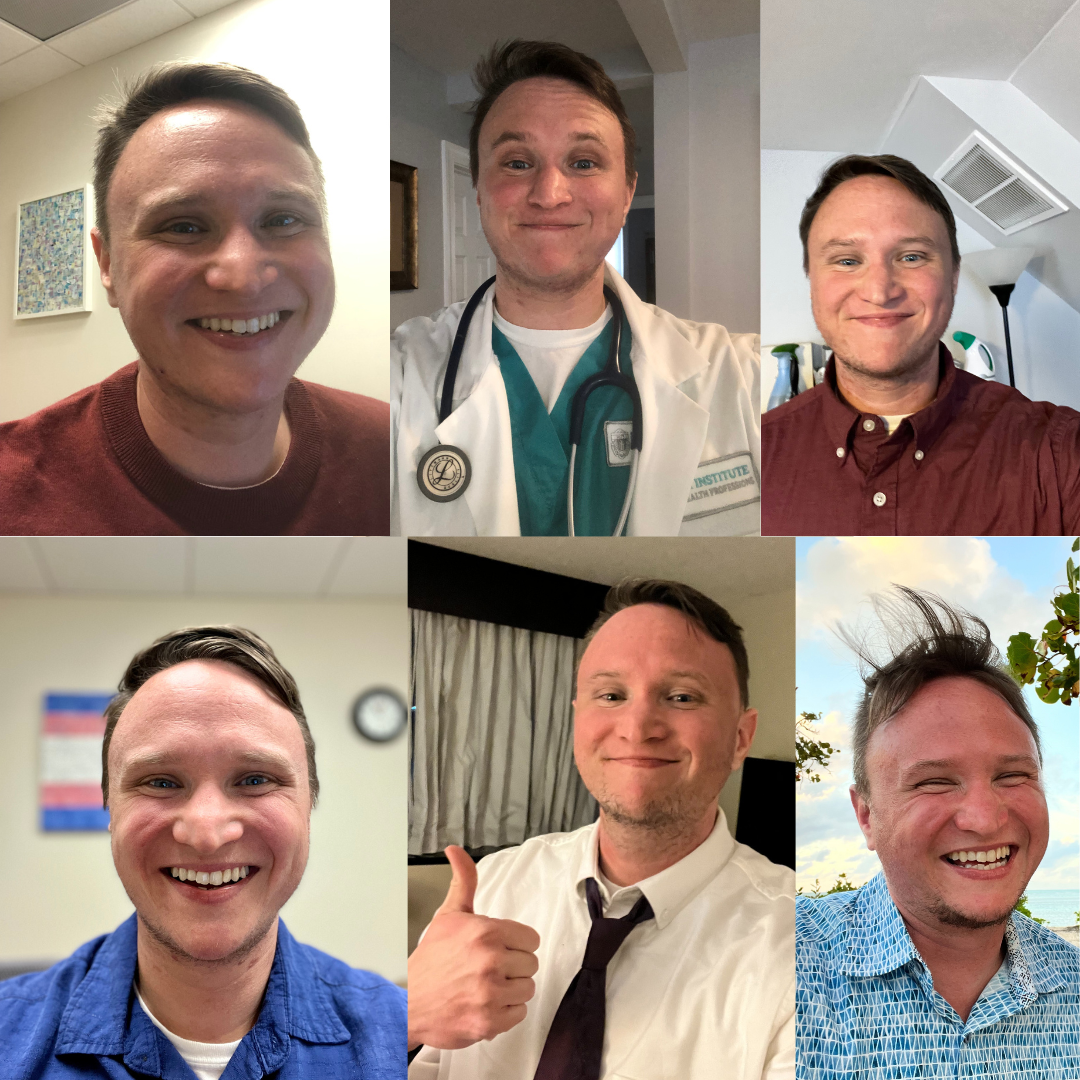
Jess Romeo is a Psychiatric Nurse Practitioner, clinical social worker, mentor, and educator with a passion for making gender-affirming care more accessible, inclusive, and informed.
With years of experience seeing patients, training healthcare providers, and being queer & trans, Jess brings a nuanced, compassionate, and engaging voice to conversations about gender identity and social justice.
Through this podcast, Jess cultivates a curious and brave space to explore the realities, challenges, and triumphs of our lives—helping providers, allies, and community members reflect, deepen their knowledge, and take meaningful action.